
Christian Almanac: Where Faith Meets Real Life
Episode 6 Transcript
The Courage to Obey
Click on the  in each section below to read the podcast segments
Back during COVID, I was working on a book project with a new client. When we started, I thought I understood what he wanted to do, and that I could help him write and publish his book without violating any of my own principles.
But as the project progressed, I realized that he wanted to share a message that not only did I not agree with, but that was inconsistent with my values.
If it was just a case of, say, he was a businessperson writing a management book with advice I didn’t think would be effective, I would have shared my concerns and then did what he wanted. But this was a book with a message that bordered on demonic.
Under our agreement, my name wouldn’t have been anywhere in the book, so I could have done the work without anyone knowing. And our business had experienced a significant downturn during COVID, so the revenue this book would have brought in was meaningful at the time.
But I couldn’t do it.
I couldn’t be a part of sharing a message I thought was spiritually dangerous.
And God had always provided for me in the past; I knew he would continue to do so, even in those challenging times. I just had to be obedient. I had to honor my commitment to doing things God’s way.
I exercised my right to cancel the agreement and walked away from the project.
Now, did a six-figure contract drop in my lap the next day? No.
But other opportunities came our way over the next several months, opportunities that were aligned with our values and that would let us sleep soundly at night. We weren’t living luxuriously, but we were paying the bills. We knew we’d done the right thing.
Following Christ is simple. It’s just not always easy.
And sometimes, obedience has a price tag.
It’s okay to question that, to want to understand it.
After all, it seems like if we’re doing things right, if we’re following what Jesus taught, life should be easy. It should overflow with opportunities and rewards, and sunshine and rainbows, right?
That’s the myth of comfortable Christianity, and it’s not how it is in the real world. Yes, sometimes things can happen that way. But sometimes we need to learn—and practice—obedience long before we see the result in the form of clarity, comfort, or reward.
Hebrews 11:1 (NIV) tells us:
Now faith is confidence in what we hope for and assurance about what we do not see.
The rest of that chapter tells us of so many people who were faithful and obedient when it was hard, when it was painful, when it meant suffering and even death.
They ultimately received their rewards, but it wasn’t always here on earth. It wasn’t always in the form of material luxuries, or in the acquisition of rank and power.
Second Corinthians 5:7 (NIV) reminds us, “For we live by faith, not by sight.”
Obedience often means moving forward without visible guarantees.
It means trusting that what we can’t see is more solid than what we can.
The reality is that being obedient to Christ can cost you in this world. It can cost you approval. It can cost you opportunity. It can cost you comfort.
Let’s talk about each of those things.
It’s human nature to want approval, but when you are obedient to Christ, you might find yourself standing alone in both business and personal situations.
You may be the only one in the room who won’t bend the numbers “just a little.”
You may decline to participate in gossip that would win you easy friendships.
You may gently but firmly hold a biblical position in a family conversation and feel the temperature in the room shift.
Approval can evaporate quickly when you won’t compromise.
Obedience to Christ may also cost you opportunity when you refuse to take shortcuts that aren’t ethical, or when you turn down opportunities that could be lucrative but would mean compromising your integrity.
It might mean passing on a deal that looks impressive on paper but just feels off. It could mean declining a promotion that requires practices you cannot in good conscience support. It may even mean waiting longer than others do for growth because you refuse to manipulate outcomes.
Finally, there’s comfort. Being obedient sometimes forces us to have difficult, uncomfortable conversations. We have to forgive when we don’t want to. We aren’t always recognized when we do the right thing.
Sometimes obedience means setting boundaries that disappoint people. Sometimes it means admitting we were wrong—and that’s rarely comfortable—and making restitution. Sometimes it means continuing to serve faithfully in a season when no one seems to notice or appreciate your effort.
But even with these costs, and as challenging as it can be, obedience produces fruit in an abundance of ways.
It builds a strength of character that we can’t develop any other way. When you choose what is right over what is easy, you strengthen your core. Each obedient decision reinforces who you are in Christ. Over time, you become less swayed by pressure because you’ve practiced standing firm.
Obedience builds integrity and trust. Integrity is simply alignment—your private convictions matching your public actions. When people see that your decisions are consistent, even when it’s not convenient, trust grows. And trust, especially in business and leadership, is a priceless asset.
Obedience builds spiritual resilience and brings you peace. Every act of obedience stretches your faith muscles. You learn that you can survive discomfort. You learn that God does, in fact, provide—not always what we want, but always what we need. And you discover that your peace is not tied to circumstances but to your closeness with him.
And obedience keeps us focused on eternity, which is what really matters.
There’s a line in C.S. Lewis’s book, The Screwtape Letters, which illustrates the value and importance of obedience in a powerful way. If you’re not familiar with this book, the story is laid out in a series of letters written by Screwtape, who is an undersecretary in the lowerarchy of Hell. The letters were written to his young and mostly incompetent nephew Wormwood, who has been assigned to his first “patient,” which is a young man. Wormwood’s mission is to influence his patient in any way he can to secure his soul for the king (or devil) in hell. The letters from Screwtape are filled with detailed instructions on how Wormwood should attack, cajole, mislead, distract, and influence his patient to ensure his allegiance to the devil and his own destruction. When Screwtape refers to the “enemy,” he’s referring to God.
In letter 8, Screwtape writes:
“Do not be deceived, Wormwood. Our cause is never more in danger than when a human, no longer desiring, but still intending, to do our Enemy’s will, looks round upon a universe from which every trace of Him seems to have vanished, and asks why he has been forsaken, and still obeys.”
Nothing frustrates Satan more than when we trust, honor, and are obedient to God, even when it doesn’t make sense, even when it’s painful, even when we wonder why God is allowing such awful things to happen.
Let me be clear. I’m not saying that being obedient to Christ guarantees a miserable life here on earth. Far from it. Billions of obedient Christians around the world live happy, comfortable, satisfying lives. There’s a joy in obedience that you won’t find anywhere else.
It’s a quiet joy. A steady joy. The kind that lets you lay your head on the pillow at night without second-guessing your compromises. It’s the deep satisfaction of knowing that even if something cost you in the short term, you honored God in the process.
Obedience, especially when there’s a cost to it, is one of the best faith-building exercises you can do.
It doesn’t need to be loud. Don’t run around announcing that you didn’t do this or you did do that because you’re being obedient. Simply practice obedience quietly, whether or not anyone else is watching.
And yes, obedience has a price tag. Sometimes it feels pretty hefty, but it’s something we can always afford. And disobedience will cost far more in the long run.
When we come back, we’ll talk about the serenity prayer. You probably know what’s commonly said at the close of most 12-step meetings, but have you heard the full version of this powerful prayer?
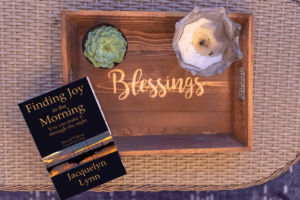
Some nights feel endless. Heavy with worry. Uncertain about what comes next.
In Finding Joy in the Morning: You Can Make It Through the Night, Jacquelyn Lynn reminds us that peace isn’t found in controlling circumstances — it’s found in trusting the One who already holds them.
This isn’t a self-help book.
It’s an I-can’t-do-it-alone book.
You’ll discover how to release anxiety, strengthen your faith, and build daily habits of joy — even in difficult seasons.
The expanded edition includes more than 40 practical joy practices and reflection questions for personal or group study.
Finding Joy in the Morning is available now on Amazon and wherever books are sold.
Welcome back.
You’ve probably heard some version of the Serenity Prayer. It’s used as part of the closing of various 12-step recovery programs.
The common version goes like this:
“God, grant me the serenity to accept the things I cannot change,
Courage to change the things I can,
And wisdom to know the difference.”
There are also a number of funny versions, such as:
“Lord, grant me the serenity to accept the things I cannot change,
the courage to change the things I can,
and the wisdom to know that if I act on my impulses, I will go to jail.”
To be serious, that short prayer has been serving the recovery community since the 1940s, when it was adopted by Alcoholics Anonymous. It’s a message that believers and non-believers need.
But it was never intended for only one group of people. It speaks to something universal, to feelings we all have—stress, control, fear, responsibility, and hope.
It was written in the early 1930s by Reinhold Niebuhr. He was an American Protestant theologian who is worthy of further study, but I’m going to stick with the Serenity Prayer here.
Occasionally questions come up about the authorship, but the overwhelming historical consensus attributes the prayer to Niebuhr.
Most of us know the shorter version, but the longer one is powerful. It’s not just a recovery prayer. It’s not just a slogan. It’s not a light-hearted way to deal with annoyances. It’s a powerful daily prayer for anyone trying to follow Christ in the real world.
It goes like this:
God, give us grace to accept with serenity
the things that cannot be changed,
courage to change the things
which should be changed,
and the wisdom to distinguish
the one from the other.
Living one day at a time,
enjoying one moment at a time,
accepting hardship as a pathway to peace,
taking, as Jesus did,
this sinful world as it is,
not as I would have it;
trusting that You will make all things right
if I surrender to Your will;
so that I may be reasonably happy in this life
and supremely happy with You forever in the next.
Amen.
Wow. What a powerful testimony.
Let’s take a closer look at it.
“Give us grace to accept …”
We all struggle with control.
There are things in your business you can’t fix today.
There are situations in your family you can’t untangle overnight, or maybe even ever.
There are cultural shifts you can’t reverse.
There are diagnoses, disappointments, and decisions that don’t bend to your will.
We have to accept that. But even as we do, we need to remember that acceptance is not inaction. It’s not indifference. It’s not giving up.
Acceptance is clarity about limits. It’s releasing the illusion that YOU are sovereign.
Psalm 46:10 reminds us, “Be still, and know that I am God” (NIV). That verse is not about inactivity; it’s about remembering who is in charge.
Then the prayer pivots.
“Courage to change the things which should be changed.”
This is not a prayer for a passive life.
Some things should be changed.
You might have a hard conversation that needs to happen.
A habit that needs to stop.
A boundary that needs to be set.
A decision that has been delayed and needs to be made.
Second Timothy 1:7 says, “For the Spirit God gave us does not make us timid, but gives us power, love and self-discipline.” (NIV).
Courage is not personality-driven. It’s Spirit-enabled.
Sure, you can develop courage, but you need God to do it.
And then comes the hardest line of all.
“The wisdom to distinguish the one from the other.”
Oh, yes. That’s where most of us live, in the tension of trying to figure out what we need to accept and what we need to try to change.
Is this something I surrender… or something I confront?
Is this patience… or avoidance?
Is this faith… or fear?
It takes wisdom to know the difference.
The prayer assumes something so true and so simple: we need wisdom every single day.
Though that would be enough,
as they say in commercials, “But wait, there’s more!”
The second half of the prayer moves even deeper.
“Living one day at a time…”
We are at our best when we live in the present, without regrets for the past or anxiety about the future.
Jesus himself said, “So don’t worry about tomorrow, for tomorrow will bring its own worries” (Matthew 6:34, NLT).
The prayer continues:
“Accepting hardship as a pathway to peace…”
That confronts the assumption that peace requires perfect circumstances.
It doesn’t.
The Bible doesn’t promise ease. It promises God’s presence.
“Taking, as Jesus did, this sinful world as it is, not as I would have it…”
Christ did not deny brokenness. He entered it. He loved within it. He redeemed through it.
“Trusting that You will make all things right if I surrender to Your will…”
Surrender is not a cop-out. It’s not escapism. It’s taking an eternal perspective.
The prayer ends with this steady hope: reasonably happy in this life, supremely happy in the next.
That’s not triumphalism. It’s grounded faith.
So what would it look like to pray this every day?
Maybe before work every morning.
Or before you respond to that email.
Before you make that decision.
Before you begin that conversation.
You might even journal three questions:
What must I accept today?
What requires courage today?
Where do I need wisdom today?
The Serenity Prayer is not just for people in crisis or recovery.
It’s for leaders under pressure.
It’s for parents navigating busy, complex lives.
It’s for entrepreneurs facing uncertainty.
Most important, it’s for believers trying to honor Christ in a complicated world.
Don’t just admire the serenity prayer.
Pray it.
And let it shape how you step into real life tomorrow.
I’ll be back in a moment with this week’s real life tip.

What if your faith shaped your decisions—not just on Sundays, but every day at work?
Christian Business Almanac is a page-a-day guide designed for values-driven entrepreneurs, leaders, and professionals who want their faith to show up where it matters most.
Each day delivers Scripture, practical insight, and thoughtful reflection—helping you integrate biblical truth into leadership, work, and life.
This isn’t theory. It’s faith applied, one day at a time.
Learn more and find purchase links at ChristianAlmanac.com.
That’s ChristianAlmanac.com.
Welcome back.
I’m not a tech expert, but I really don’t think there’s a limit to the number of tabs you can have open in Google Chrome. At least, I haven’t hit it, and Jerry will tell you that I’ve tried.
By the way, there’s a name for people who keep many browser tabs open at the same time. We’re called tab hoarders.
And when I have what seems like a zillion tabs open, sometimes I have trouble finding the tab I want to get to.
If you can relate to that, you’ll love this week’s real life tip. It’s a simple, sanity-saving way to navigate your open tabs.
In any open tab, hold down the control, shift and A keys. A sidebar will pop up showing all your open and recently closed tabs.
CTRL + Shift + A
If you don’t have many open, you can simply scan the list. Or you can use the search feature at the top of the sidebar to find what you’re looking for.
From that sidebar, you can jump to tabs, or you can close the ones you don’t need.
And because it shows recently closed tabs, it can save you if you closed a tab and you need to get back to it.
The sidebar will close when you click off of it.
This is a Chrome feature. It also works in Microsoft Edge, but not in Firefox. I don’t know about other browsers, but you can try if you use something different.
If you’re a tab hoarder like me, I hope this tip helps make your digital life a little easier.
Thanks for being here. See you next week.