
Christian Almanac: Where Faith Meets Real Life
Episode 3 Transcript
Success, Ambition, and the Christian Tension
Click on the  in each section below to read the podcast segments
Let’s talk about success, ambition, and the internal tension many Christians experience when they try to balance wanting to do well and make an impact while still being faithful to what Christ taught. This tension is common, especially for people who take both their faith and their worldly responsibilities seriously.
You work hard. You care about excellence. You want to see results. You want what you to do matter.
Is this ego? Maybe. Or maybe these feelings come from a sense of calling and responsibility.
At the same time, you want to be respected and even admired. You want a certain amount of material comforts. You want to drive a nice car, live in a nice house, have nice things. You want your kids to go to good schools. You want to be able to make financial contributions to your church and missions you support.
You have a desire for stability, for providing for your family, for giving generously, for taking advantage of opportunities. When does this desire change from calling and responsibility to excess?
And that’s where, for many Christians, a tension develops.
You’ve got questions that often don’t have clear answers.
Success as the world defines it includes achieving a certain rank or status along with having and enjoying material things. Where is the line between that and being faithful to the Gospel?
How much is “enough”? And how do you pursue more than enough without losing your spiritual grounding?
As Christians, we get a lot of mixed messages about ambition and success.
We’re told to be grateful for what we have, to be humble.
In First Thessalonians, Paul wrote:
Be thankful in all circumstances, for this is God’s will for you who belong to Christ Jesus. (1 Thessalonians 5:18, NLT)
The Apostle Peter wrote:
Humble yourselves, therefore, under God’s mighty hand, that he may lift you up in due time. (1 Peter 5:6, NIV)
But throughout the Bible, God has used wealthy people to do his work.
There was Abraham, whose resources enabled him to lead and bless others.
And Job, who retained his faith through loss and restoration.
And Joseph, who managed Egypt’s resources during famine.
And David, who funded preparations for the temple.
There’s the “prominent woman of Shunem” in Second Kings. She provided hospitality to the prophet Elisha and used her resources to build a furnished room for him in her home. Her wealth and influence became infrastructure for God’s work.
And, of course, Solomon, whose wealth and wisdom shaped a nation and who continues to guide business leaders today.
All of these and more were materially successful and still deeply involved in God’s purposes.
And God hasn’t stopped using wealthy people. Consider the good works of
John D. Rockefeller, who was influenced by a Baptist preacher who told him to make as much money as he could and then give away as much as he could. He donated to churches, to education, to medical research, and so much more.
How about Andrew Carnegie, who built libraries, supported education and worked for world peace, and called on the rich to use their wealth to improve society.
There was Madame C. J. Walker, one of the first self-made female millionaires in the United States. She used her success to expand opportunity for others by contributing to civil rights and community initiatives, funding scholarships, and investing in education and housing.
Then there was Henry Ford, whose policies on wages and working hours along with his philanthropy reshaped the middle class.
George Peabody, who was born into a poor family but became a wealthy financier and philanthropist, is considered the father of modern philanthropy.
And George Cadbury did more than make delicious chocolates, he invested in worker welfare, education, and housing.
These men and women weren’t perfect, but I absolutely believe they were God’s tools.
Wanting to grow, to be a leader, to achieve career and material success is not inherently unchristian. In fact, our intellect, our talents, and our abilities are all gifts from God, and he wants us to use them. Stewardship applies not only to what we have, but what we do and what we have the potential to do.
I love the quote by Leo Buscaglia. He said, “Your talent is God’s gift to you. What you do with it is your gift back to God.”
To take what God has given you and use it in a way that glorifies him usually requires ambition. It requires initiative, effort, learning, and persistence.
Faith doesn’t eliminate ambition, it directs it. Being a Christian doesn’t mean we need to shrink our goals, it means we should examine our reasons for them.
The question isn’t whether we want success, but WHY we want it and HOW we pursue it.
A desire to be successful does not mean you’re selfish. A desire for influence doesn’t have to mean you’re corrupt. Those desires can be expressions of responsibility and benevolence rather than ego.
Consider that successful businesses create jobs and opportunities. They provide goods and services people want and need. And they need to be led by skilled, ambitious people.
Successful doctors provide essential medical care. Life-changing medical advances require ambitious researchers and practitioners.
Successful educators shape future generations and open doors of opportunity, but it takes ambition to reach the level of skill and knowledge required to do that.
We can be grateful and humble, and still want success. It comes down to our motivation. Gratitude keeps success from becoming entitlement. Humility keeps ambition from becoming domination.
If your drive for success comes from a desire to glorify God and live his plan for your life, there’s no conflict between what you’re doing and your faith. But if it comes from a desire for status and power, you may need to do some self-examination and make some changes to achieve the clarity and peace you want.
That kind of reflection isn’t about guilt or selfishness, it’s about alignment.
When we come back, we’ll talk about some practical ways to keep ambition aligned with faith.
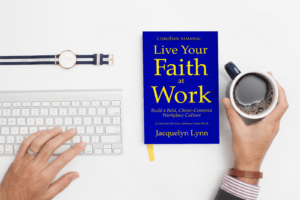
What would change if your faith shaped how you lead, decide, and treat people at work?
Live Your Faith at Work is a concise, practical guide for business owners, leaders, and professionals who don’t want their faith compartmentalized.
This Christian Business Almanac Focus book delivers clear, easy-to-apply direction for building a Christ-centered workplace culture—through leadership habits, communication, integrity, and care for people.
It’s not inspiration. It’s application.
Learn more and find purchase links at ChristianAlmanac.com.
That’s ChristianAlmanac.com.
Welcome back.
In the first segment, we talked about the internal tension many Christians feel between ambition and faithfulness. That tension is a good thing. It shows awareness and a desire to live our faith in the real world.
What we need to do now is move from tension to clarity and understanding.
Let’s begin with a few definitions.
The definition of ambition is “a strong desire to do or achieve something, typically requiring determination and hard work.”
The definition of success is “the accomplishment of an aim or purpose.”
So, in and of themselves, ambition and the desire for success are neutral. The difference comes in how you approach them.
Biblical success is built on faithfulness, obedience to God, and fulfilling the specific purpose for which we were created. It’s measured by what’s in our hearts, not by worldly goods. It’s about serving others and being good stewards of the gifts God has given us. It’s about eternity, not the limited time we have here on earth.
In First Corinthians, the apostle Paul reminds us that “Now it is required that those who have been given a trust must prove faithful.” (1 Corinthians 4:2, NIV)
Notice what is required—it’s faithfulness, not fame. Not applause. Not even visible results. Faithfulness.
Worldly success is measured by status, fame, material wealth, influence, and public recognition. It’s often quantified by titles, awards, square footage, fans and follower counts, and the ability to control outcomes or people.
Sometimes biblical success is quiet and modest. Sometimes it comes with the trappings of worldly success.
Remember, Scripture does not condemn wealth or leadership. It shows us how God uses those things. And it warns us about what captures our hearts. Jesus said, “For where your treasure is, there your heart will be also” (Matthew 6:21, NIV).
It’s not about our possessions, it’s about our priorities.
How can you tell if your ambition is faithful?
Begin by defining what it is you truly want. Be honest. No false modesty here. If you want the huge company, the elegant office, big house and fancy cars, even a corporate jet, articulate that. You’ve got to know what success means to you before you can figure out if what you want is aligned with God’s purpose.
This kind of clarity is not arrogance. It’s honesty before God.
Think about all the goal-setting exercises you’ve read and probably done, where we’re told to create goals that are specific and measurable. You can’t achieve or surrender something you can’t name. So define what you truly want.
Next, do a three-part check:
Motive. Integrity, and Stewardship.
For motive, ask yourself WHY you want what you want. Is it about service or self-elevation? Would you still want it if no one noticed? Would you still pursue it if someone else received the credit? Would you still want it if it meant years of unseen, uncelebrated effort?
For integrity, ask yourself if you can do this without compromising your values and convictions. Can you do it without cheating or manipulation or breaking rules? Would you be comfortable if every decision you made in pursuit of your goal were made public?
For stewardship, ask yourself if the gifts God has entrusted you with
align with the opportunities success will bring.
Is it a true expansion of God’s purpose for you or is it a distraction? Success has a way of multiplying responsibility. Luke 12:48 (NLT) tells us, “When someone has been given much, much will be required in return; and when someone has been entrusted with much, even more will be required.” Are you prepared to steward not only the opportunity, but everything else that comes with it?
These are not simple questions. They require deep thought and reflection. And a level of honesty that might be painful.
Is what you want truly your calling? Or are you trying to prove something to someone or heal a hurt?
Sometimes ambition is fueled by old wounds, by something that happened as a child, a career setback, a desire to silence critics. Sometimes we’re being pushed by insecurity rather than being pulled by God’s call.
There is a difference between being led and being driven. Being led brings peace, even when it’s hard. Being driven brings urgency and anxiety, even when you’re succeeding.
Even once we feel grounded, once we’re sure we know what we’re supposed to be doing, we can drift off course, we can shift away from faithfulness to worldliness.
Some signs that this might be happening include feeling resentful when others are successful, feeling anxiety about getting the recognition you want, and neglecting your family, your health, and your spiritual life.
Another sign is when your prayer life shrinks as your platform grows. Or when busyness replaces dependence on God. Or when your metrics matter more to you than your character.
When your ambition replaces your identity, it becomes dangerous. It can pull you down a worldly path that will leave you without peace and joy.
Proverbs 16:3 (CSB) gives us a practical anchor: “Commit your activities to the Lord, and your plans will be established.” Commitment comes first. Establishment follows. When we reverse that order—when we establish first and commit later—we step onto unstable ground.
Remember, it’s not wrong to want to do meaningful work, to see and enjoy the fruits of your labors. It’s not wrong to care about excellence and to want what you to do matter. It’s not wrong to want to be respected and to live a comfortable, stable life. It’s not wrong to want the resources so you can be generous.
We just have to be sure we want those things for the right reasons. It’s not about how high we can climb, it’s about how faithfully we can walk. And that’s where we need to direct our ambition.
I’ll be back in a moment with this week’s real life tip.

Most leaders don’t struggle with believing—they struggle with applying.
Christian Business Almanac bridges that gap.
This page-a-day resource brings Scripture, wisdom, and practical perspective into the real decisions you face at work and in leadership—day after day, all year long.
No fluff. No shortcuts. Just steady, biblical guidance for people who want their faith fully integrated with how they lead, work, and live.
Discover more and find purchase links at ChristianAlmanac.com.
That’s ChristianAlmanac.com.
This week’s real life tip is one of those things that might make you say Duh! Doesn’t everyone know that?
We have some solar powered lights in our yard. They’re convenient for places we either can’t or don’t want to run electricity to.
For example, we have a bird feeder with a camera that’s solar powered. We have some decorative lights, including a pair of pink flamingos that I think are cute and my husband thinks are tacky.
But the tip isn’t about our difference of opinion. It’s about when some of the solar lights we were using to illuminate some dark areas in the backyard stopped working.
We checked to make sure the lights were turned on and adjusted the positioning of the solar panels—they still didn’t work. I was ready to throw them out and get new ones.
And then our grandson noticed that the solar panels were dirty with mud and grass clippings. Leave it to the kids, right?
He cleaned the panels and that night the lights were as bright as the day we installed them.
So this week’s tip is: When solar lights aren’t working, make sure the solar panels are clean.
And if you feel like your own spiritual lights aren’t as bright as they should be, make sure your metaphorical solar panels are clean and that nothing is blocking you from receiving God’s energy.
Thanks for being here. See you next week.