
Christian Almanac: Where Faith Meets Real Life
Episode 8 Transcript
Work, Burnout, and Faithful Boundaries
Click on the  in each section below to read the podcast segments
Let’s talk about something many of us feel… but don’t always admit.
Burnout.
You can love your work and still feel exhausted by it.
You can feel called and still feel depleted.
You can be doing good, meaningful, important things… and be quietly unravelling on the inside.
And sometimes things change. Something you once loved doing has turned into a burden and you just don’t want to do it anymore, but you feel like you can’t quit.
Burnout doesn’t always look dramatic.
It doesn’t always mean you can’t get out of bed. In fact, if that’s where you are, you might be suffering from depression, and I urge you to get professional treatment.
The symptoms of burnout can be subtle. It can show up as cynicism, irritability, exhaustion, or reduced efficiency. Sometimes you’re doing all the right things but there’s no joy in them.
Burnout can be caused by overwork, but for Christians, burnout is often more than a workload issue.
It can be a faith issue.
Let’s define what we’re talking about.
Psychologists generally describe burnout as a state of emotional, physical, and mental exhaustion caused by prolonged stress. It typically includes three components: emotional exhaustion, a growing sense of detachment or cynicism, and a reduced sense of effectiveness.
In other words, you’re tired… you’re starting not to care… and you don’t feel like you’re doing anything well.
That’s different from just having a busy week or needing a good night’s sleep.
Now, to be clear: burnout can absolutely have physical causes, medical causes, and organizational causes. Chronic overwork, unclear expectations, toxic leadership, constant digital accessibility — those things are common issues many of us are dealing with, and when they get overwhelming, they can cause burnout.
Something that may be confused with burnout is compassion fatigue. It’s real, especially in ministry, caregiving, and volunteer-heavy environments. Though it might feel like burnout, it’s different.
We’re focusing on burnout here. And when it comes to burnout, not everything is spiritual.
But for believers, there are often spiritual drivers beneath the exhaustion.
Sometimes burnout grows out of a subtle belief that everything depends on us.
We may never say it out loud.
But we live like it.
If I don’t handle this, it won’t get done—or it won’t get done right.
If I don’t say yes, everything will fall apart. They can’t do without me.
If I step back, I’m letting God down because I’m not serving.
That’s not faith.
That’s a form of control. That’s us trying to be in charge instead of letting God run things.
Sometimes burnout comes from confusing productivity with worth.
We think: If I’m producing, I’m valuable.
If I’m needed, I matter.
If I’m busy for God, I’m faithful.
But Scripture reminds us that our value isn’t rooted in output. “We are God’s workmanship, created in Christ Jesus for good works” (Ephesians 2:10, NKJV). Notice the order: we are His workmanship first. The work flows from identity — not the other way around.
Another spiritual driver of burnout is misunderstood sacrifice.
There’s a difference between sacrificial seasons and chronic self-neglect.
Jesus calls us to take up our cross.
He does not call us to permanently ignore the limits of our humanity.
Psalm 127:2 says, “In vain you rise early and stay up late, toiling for food to eat — for he grants sleep to those he loves” (NIV).
We need rest. We are made for a cycle of work and rest.
Sleep is not weakness.
Rest is not laziness.
It’s a gift given to people God loves.
Burnout can also grow when we fuse our identity with our assignment.
If I stopped doing this… who would I be?
That’s an important question.
Because if your entire sense of self is tied to your role — your job, your ministry, your volunteer leadership — then stepping back feels like erasing yourself.
That’s not stewardship. That’s entanglement.
And your role
is not who you are.
So how do you know if you’re approaching burnout?
You might feel tired in a way that rest doesn’t fix.
You might notice you’re more irritable than usual, and it’s making you feel off-center and affecting your relationships.
Small things feel big.
Decisions, even minor ones, feel heavy.
Work you once loved now feels like obligation.
When these feelings creep in, you may find yourself withdrawing.
Or resenting the very people you once felt called to serve.
If you can identify with that, even a little, it’s a red flag.
If you lead a team — whether it’s part of your professional role or you’re doing it as a volunteer — you want to be aware of the possibility of burnout in your people.
High-capacity deeply committed people are often the most vulnerable to burnout. They say yes quickly. They stay late. They carry more than they admit.
And they are often the last to tell you when they’re struggling. So watch for changes in their engagement, in their productivity, in their moods and attitudes.
While productivity can be an indicator of burnout, that’s not the only thing burnout affects.
It affects decision-making.
It affects relationships.
It affects spiritual sensitivity.
It affects your witness.
Exhaustion has a way of distorting perspective.
When we’re depleted, we’re more reactive.
Less patient.
Less generous.
Less discerning.
And over time, unaddressed burnout can lead to bitterness — even toward the work God once clearly called us to do.
Colossians 3:23 tells us, “Whatever you do, work at it with all your heart, as working for the Lord” (NIV).
But working “with all your heart” does NOT mean working at a level beyond your capacity that you can’t and shouldn’t sustain. It doesn’t mean working without boundaries. It doesn’t mean ignoring how God made us—remember we were made for rest and balance. It doesn’t mean pretending that we have a limitless capacity. We don’t.
God intended for us to work. It’s the first thing he did when he created the world—he gave Adam a job. But he never meant for work to replace Him.
God also wants us to serve, but he never meant for service to destroy the servant.
If you’re feeling stretched thin right now, this is not a condemnation. It’s an invitation.
An invitation to examine not just your calendar…
but your theology.
In the next segment, we’re going to talk about solutions to burnout.
Work, rest, stewardship, and how to say no without guilt.
Because faithfulness is not measured by exhaustion.
And healthy rhythm is not a lack of commitment — it’s wisdom.
I’ll be back in a moment.
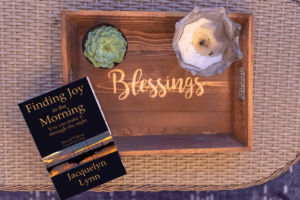
Some nights feel endless. Heavy with worry. Uncertain about what comes next.
In Finding Joy in the Morning: You Can Make It Through the Night, Jacquelyn Lynn reminds us that peace isn’t found in controlling circumstances — it’s found in trusting the One who already holds them.
This isn’t a self-help book.
It’s an I-can’t-do-it-alone book.
You’ll discover how to release anxiety, strengthen your faith, and build daily habits of joy — even in difficult seasons.
The expanded edition includes more than 40 practical joy practices and reflection questions for personal or group study.
Finding Joy in the Morning is available now on Amazon and wherever books are sold.
Welcome back.
In the first segment, we talked about burnout and how it’s often more than a workload issue. Sometimes it’s a belief issue. An identity issue. A stewardship issue.
So now let’s talk about solutions.
The solution is not a dramatic overhaul. Those don’t work, anyway.
It’s not quitting everything. Nor is it ricocheting from overwork to avoidance. Again, those tactics don’t work.
What we need is a healthy rhythm.
Because work and rest are not enemies. They’re partners.
We know that God does work. He worked to create us and our world, and he continues to work as he listens to us, guides us, and responds to our prayers. So God works and he rests. Scripture is very clear on that. Genesis tells us:
By the seventh day God had finished the work he had been doing; so on the seventh day he rested from all his work. Then God blessed the seventh day and made it holy, because on it he rested from all the work of creating that he had done. (Genesis 2:2-3, NIV)
That same chapter tells us that God created Adam and put him to work taking care of the Garden of Eden. Work is part of God’s design.
It’s dignified. It’s purposeful.
But so is rest.
Before the Ten Commandments were given, before Israel was established as a nation, God modeled the rhythm of work and rest. He wasn’t tired. God might find our faithlessness tiresome, but he doesn’t get physically tired.
The prophet Isaiah tells us plainly:
The Lord is the everlasting God,
the Creator of the ends of the earth.
He will not grow tired or weary,
and his understanding no one can fathom. (Isaiah 40:28, NIV)
God didn’t rest because he was tired. He rested to establish a pattern.
Rest is not weakness. It’s obedience.
And here’s where many of us get off track.
We begin to act like owners instead of stewards.
A steward manages what belongs to someone else. An owner carries ultimate responsibility.
You are a steward of your time.
A steward of your energy.
A steward of your body.
A steward of your family.
A steward of your calling.
You are not the ultimate owner of outcomes. God is.
When we forget that, burnout accelerates.
We start believing that everything depends on us. We grip tightly. We overcommit. We over-function. We say yes to things that were never actually assigned to us.
First Peter 5:7 says, “Cast all your anxiety on him because he cares for you” (NIV).
Notice the word cast.
That implies release.
Some of us aren’t burned out because we work hard. We’re burned out because we won’t release what was never ours to carry.
Now let’s talk about something practical — and, for too many of us, uncomfortable.
That’s saying no.
For many believers, saying no feels unspiritual.
We worry that if we don’t volunteer, who will? That if we turn down a request, people will think we’re selfish. Or that if we step back, we’ll lose influence.
Somewhere along the way, we absorbed the idea that a good Christian always says yes.
But that’s not what we see in the life of Jesus.
There were times when He withdrew from the crowds.
Times when He left needs unmet.
Times when He did not heal everyone in a town.
The first chapter in Mark describes people searching for Jesus because more were waiting to be healed. Jesus had gotten up early and gone off to a desert place where he prayed. When the disciples finally found him, they said, “Everyone is looking for you!” Jesus responded by saying, “Let us go on to the nearby villages that I may preach there also. For this purpose have I come.”(Mark 1:35-38, NIV).
Here’s what we learn from that: Jesus took time to go off alone, to pray and recharge. It was a form of rest. And when the disciples found him, he didn’t jump back into the healing he had been doing the night before, he told them he wanted to fulfill his purpose, to do what he came for.
Can what the disciples said describe your life?
Is everyone looking for you?
But Jesus was guided by purpose, not pressure.
That’s the model we need to follow. And the best way to do it is with boundaries. Not just arbitrary limits or refusals, but by building faith-informed boundaries.
Here are five practical steps to do that.
First, clarify your primary assignments.
What has God clearly entrusted to you in this season? Not ten years from now. Not five roles from now. Now, in this season.
When you’re clear on that, it becomes easier to recognize what is extra.
Second, audit your commitments.
Not just paid work. Volunteer work. Church roles. Family responsibilities. Emotional labor. Digital obligations. Everything counts against your energy.
If your calendar has no margin, your soul probably doesn’t either.
Third, establish non-negotiable rhythms.
That might be a weekly Sabbath window.
Device-free evenings.
A protected day off.
A quarterly review of commitments.
Exodus 20 verse 8 says, “Remember the Sabbath day by keeping it holy” (Exodus 20:8, NIV).
Some people believe we should be very rigid in our Sabbath observance; others are more flexible. Charlie Kirk, for example, observed the Sabbath from sundown Friday to sundown Saturday, but he admitted that he would occasionally work on a Saturday, and when he did, he would observe the Sabbath on Sunday.
So establish your non-negotiable rhythms that will help you recharge.
Fourth, create decision filters.
Before you say yes to anything, ask:
Is this aligned with my calling? Not just worthwhile, but aligned with your calling.
Do I truly have capacity right now? Consider the time, resources and energy you’ll need.
What will I have to neglect if I accept this? If your schedule is already full, you’ll have to change something.
Every yes has a cost.
Figure out what that cost is and choose consciously.
Fifth, practice gracious no’s.
I’m fond of saying, “No is a complete sentence.” And it is. But it also doesn’t hurt to be gracious when we say it.
You don’t need a detailed explanation. You don’t need to defend your limits.
Simple phrases work:
Like “That deserves more attention than I can give.”
Or “Thank you for thinking of me, but I’m going to say no.”
Or “No, but I appreciate the opportunity.”
Don’t say, “I wish I could, but …” unless you really wish you could and you’re looking for assistance in figuring out a way to do it.
Another thing to remember about saying no is that boundaries do not require apology.
Boundaries are important for all of us, but if you’re a leader — whether it’s in business, in ministry, or in volunteer settings — they matter even more.
You need to model rest.
If you never disconnect, your team won’t feel like they can.
Don’t reward overwork as heroism.
If you’re managing volunteers, protect them from chronic overuse.
A pastor I know once told me that one of the things seminary students are taught is to find good volunteers and ride them until they collapse, then go find more. Now, I think he was kidding, but that’s often the culture in churches and other volunteer organizations.
Sadly, the most faithful people are often the most overextended. Be the change they need.
Burnout prevention is easier than burnout recovery.
None of this is about becoming less committed.
It’s about becoming more sustainable.
Remember what Ecclesiastes tells us: “There is a time for everything, and a season for every activity under the heavens” (Ecclesiastes 3:1, NIV).
There are seasons of intensity.
And there are seasons of restoration.
Those seasons cycle throughout our lives. Be sure you’re spending sufficient time in both.
Remember, you are not more faithful because you are exhausted.
You are not more spiritual because you are indispensable.
And the kingdom of God will not collapse if you rest.
Faithfulness is not frenzy.
Stewardship is not striving.
Healthy rhythm is not selfishness.
It’s trust.
And trust is always a faith issue.
Take a look at your calendar this week.
Not with guilt.
Not with anxiety.
Not with fear.
But with the quiet confidence that the same God who called you to work… also calls you to rest because he doesn’t want you to burn out.
And if something needs to shift, make that faithful adjustment.
Trust that honoring your limits is not a lack of commitment — it’s an act of obedience.
I’ll be back in a moment with this week’s real life tip.

What if your faith shaped your decisions—not just on Sundays, but every day at work?
Christian Business Almanac is a page-a-day guide designed for values-driven entrepreneurs, leaders, and professionals who want their faith to show up where it matters most.
Each day delivers Scripture, practical insight, and thoughtful reflection—helping you integrate biblical truth into leadership, work, and life.
This isn’t theory. It’s faith applied, one day at a time.
Learn more and find purchase links at ChristianAlmanac.com.
That’s ChristianAlmanac.com.
This week’s real life tip can help protect you from fraud.
When someone tells you that you look familiar, how do you respond?
Because we want to be friendly and helpful, most of us will volunteer personal information
such as where we live, work, or go to church,
where our kids go to school,
and so on as we try to figure out the connection.
Doing that may put us at risk of identity theft.
My friend Connie Martin is a Maxwell Leadership Certified Coach and author. She taught me this. She said that “you look familiar” line is a common social engineering trick. It’s designed to use deception to manipulate people into divulging confidential or personal information that can then be used for fraudulent purposes.
Before you start revealing too much information to someone you don’t know, try these techniques:
Ask the person’s name. Don’t be embarrassed about admitting you don’t know who they are—if they’re truthfully saying that you look familiar, they’ve obviously forgotten your name, so you’re on equal ground. And if they don’t want to tell you their name, or they don’t give you their full name, that’s a red flag.
Turn their questions around. If they ask what you do, answer in general terms and ask what they do. If they ask where you went to school, answer with something like, “Oh, it’s a long list. Where did you go to school?” If they ask about your kids, you can say, “They have forbade me to talk about them. How old are yours?”
Be vague. If they ask where you work, give them a city, not the name of the company. And then ask them the same question.
Ask for a business card. Tell them you’ll reach out if you can remember where you’ve met. You may or may not want to offer your own card—it’s a judgment call you’ll need to make based on the situation.
As the saying goes, “It’s not paranoia if they’re really out to get you.” And sadly, scammers are all over the place and they’re really out to get us. Be careful and don’t be a victim.
Thanks for being here. See you next week.