
Christian Almanac: Where Faith Meets Real Life
Episode 31 Transcript
Transcript: What’s Still Yours to Do
Click on the  in each section below to read the podcast segments
You cannot control every outcome, every person, or even every feeling that arises—but you still have choices about what happens next. In Episode 31 of Christian Almanac, Jacquelyn Lynn looks at trusting God while doing what is yours to do and responding wisely when your feelings don’t tell the whole story.
There are certain things Christians say that are absolutely true:
“Turn it over to God.”
“God is in control.”
“Trust God.”
And sometimes those are exactly the words we need to hear.
But there’s a danger if we turn those truths into an excuse for passivity.
Trusting God doesn’t mean we stop planning. It doesn’t mean we stop making decisions. It doesn’t mean we sit around waiting for God to do things he has given us the ability—and the responsibility—to do.
There’s a verse in Proverbs that captures this tension beautifully:
“The horse is made ready for the day of battle, but victory rests with the Lord.” (Proverbs 21:31, NIV)
Notice both parts.
The horse is made ready.
That means somebody has work to do.
But victory rests with the Lord.
We prepare. We plan. We work. We make wise decisions. And then we recognize that the outcome was never completely under our control.
I think sometimes we confuse surrender with resignation.
Surrender says, “God, I’m going to faithfully do what I can, and trust you with what I can’t.”
Resignation says, “There’s nothing I can do, so I won’t do anything.”
Those are not the same thing.
Years ago, I wrote a blog about getting results in your life. I used the term “highest and best use.” In real estate, it refers to using a piece of property in the most productive or valuable way.
I suggested applying the same idea to our time.
I still think there’s value in that, although I’d say it a little differently today.
The highest and best use of every minute is not necessarily to cram another task into it. Sometimes the best use of an hour is concentrated work. Sometimes it’s solving a problem. Sometimes it’s talking with someone who needs you. Sometimes it’s prayer. And sometimes it’s taking a nap.
The point is to intentionally use the time and resources we’ve been given instead of simply reacting to whatever happens next.
That requires planning.
And planning is biblical. Proverbs 16:3 says, “Commit to the Lord whatever you do, and he will establish your plans.” (Proverbs 16:3, NIV)
Again, there are two pieces: we make plans, and we commit them to God.
James gives us the other side of that. In James 4, he warns people who confidently announce what they’re going to do tomorrow, where they’re going to go, and how much money they’re going to make. His point isn’t that planning is wrong. It’s that we should never confuse a plan with a guarantee.
We should plan with humility.
So what does that look like in real life?
For one thing, put your priorities where they’ll actually get your attention.
We often hear that your number-one priority should be the first thing you do every morning. Maybe. But that doesn’t work for everybody or for every responsibility.
Put important work where you have the energy, concentration, time, and resources to do it well.
If your best thinking happens at ten in the morning, protect that time for the work that requires your best thinking. Save the routine tasks—the things that don’t require as much concentration—for another part of the day.
That’s stewardship.
And part of stewarding our time well is deciding who—or what—gets access to it.
That’s why we need to protect at least some of our time.
An open door can be a wonderful gesture of accessibility. But an open door all day long can also mean you never accomplish the work you’re responsible for doing.
You can be available to people without being available every minute.
Sometimes you need to close the door. Silence the phone. Turn off notifications. Stay off social media for an hour and finish something.
That isn’t selfish. It’s recognizing that interruptions have a cost.
The other side of that is that we should respect other people’s time, too.
If we believe our time has value, we should treat other people’s time as though it has value.
Show up when you said you would. Be prepared. Don’t turn a twenty-minute meeting into an hour because you didn’t organize your thoughts beforehand.
And when you need information, ask clear questions so you aren’t making someone else spend half a day figuring out what you actually wanted.
Managing time well also means being realistic about how much we can actually do.
So know your limitations.
This is a big one.
Being responsible doesn’t mean doing everything yourself.
You have a limited amount of time. You have limited energy. You have certain abilities and not others.
Sometimes the wisest thing you can do is delegate something to somebody who can do it faster or better.
Sometimes the wisest thing you can do is say no.
And sometimes the most faithful response to an opportunity is, “I don’t have the capacity for that right now.”
Overcommitting yourself doesn’t make you more productive. Eventually, it usually makes you less effective at everything.
And recognizing our limitations also means recognizing that we need rest.
Build rest into your plan.
Rest is not what happens if you somehow finish everything else.
Because you’re probably never going to finish everything else.
There will always be another email, another project, another chore, another problem that could use your attention.
We were not designed to operate continuously.
So sleep. Take breaks. Take a walk. Sit quietly for a few minutes. Take the nap if you need it.
Rest isn’t wasted time if it allows you to return to your responsibilities with the energy and clarity to do them well.
And finally, let go of perfection when perfection isn’t required.
Some things need to be exactly right.
A lot of things don’t.
There comes a point when another fifteen minutes of tweaking isn’t making something meaningfully better. It’s just keeping you from moving on to the next thing.
Do good work. Be conscientious. Correct mistakes when you find them.
But don’t let perfectionism masquerade as excellence.
And through all of this, remember that productivity isn’t the ultimate goal.
Faithfulness is.
We don’t know what tomorrow will bring. We can’t control what other people do. We can’t guarantee that our plans will succeed. We can’t prevent every interruption, setback, disappointment, or unexpected change.
Those things belong outside our control.
But there’s still plenty that belongs inside our responsibility.
We can prepare the horse.
We can organize our time.
We can make the phone call.
We can do the research.
We can show up prepared.
We can make the decision we’ve been avoiding.
We can rest when we need rest.
We can take the next step.
And then we can trust God with what happens after that.
So yes, turn it over to God.
Yes, remember that God is in control.
Yes, trust him.
But trusting God doesn’t mean doing nothing.
Sometimes one of the clearest expressions of trust is to faithfully do everything that is ours to do—and leave everything that isn’t with God.
When we come back, we’ll talk about another part of life we need to handle wisely—what to do when our feelings are real, powerful, and not necessarily telling us the whole truth.
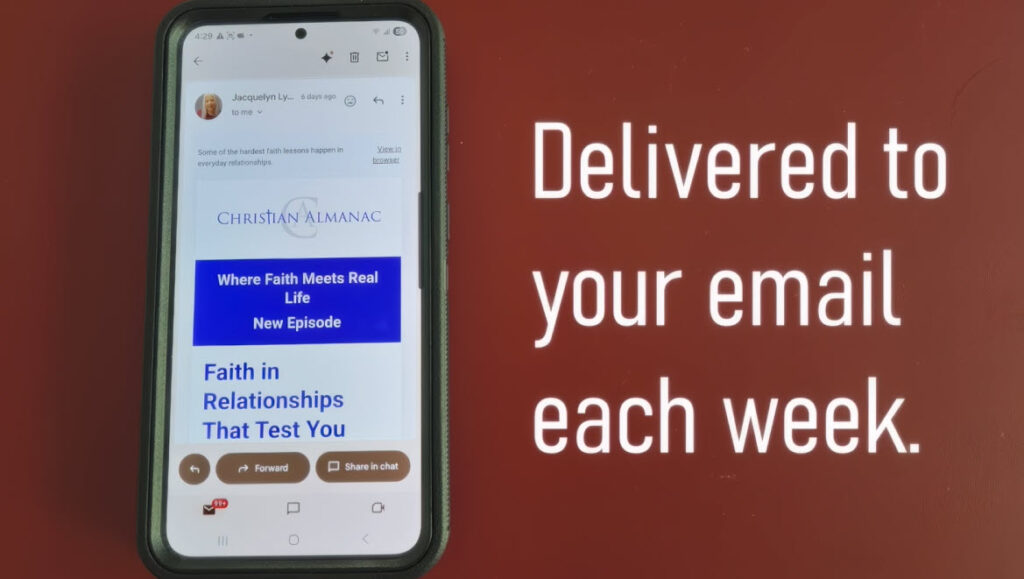
If you’re serious about integrating faith into the decisions you make every day, don’t leave it to chance.
Join the Christian Almanac email list, and each new episode will be delivered to your inbox as soon as it’s released.
No extra effort. Just clear, consistent input when it matters most.
You’ll also receive Shareable Saturday—concise insights you can apply immediately or share with your team.
Sign up at ChristianAlmanac.com/connect
Welcome back.
I’ve mentioned before that I like to read advice columns.
And one of the questions people ask surprisingly often is some version of, “Am I wrong to feel this way?”
Whenever I read that, I think: Your feelings aren’t really the part that’s right or wrong. You feel what you feel.
But that doesn’t mean every feeling gives you an accurate picture of what’s happening. And it doesn’t mean every feeling should determine what you do next.
A feeling can be real without necessarily telling you the whole truth about a situation.
You may feel ignored or disrespected even when the other person had no intention of making you feel that way. Or you may feel hurt because somebody really did treat you badly.
So when a feeling is troubling you, instead of asking whether you’re allowed to feel it, it may be more useful to ask what that feeling is telling you.
Start by figuring out what you’re actually feeling.
Sometimes we just say, “I’m upset.”
But what does that mean?
Maybe you’re angry or disappointed. Maybe you’re embarrassed, jealous, or afraid. Or maybe what you’re really feeling is hurt, resentment, rejection, or betrayal.
Naming the feeling can help you understand what’s behind it.
What are you reacting to?
What do you know for certain, and what are you assuming?
Is this really about what happened today, or did something today trigger an older hurt?
And are you assigning a motive to someone without knowing whether that motive is actually there?
Our feelings give us information. They don’t always give us the final verdict.
Once you have some idea what you’re feeling and why, then you can decide whether there’s anything you need to do.
Sometimes there isn’t.
You may be disappointed by someone’s choice, sad because something didn’t work out, or left out of something you wanted to be part of.
And there may be no action that will change any of that.
Sometimes dealing with a feeling doesn’t mean solving the situation. There may be nothing to solve—just something we have to accept.
Other times, though, the feeling is telling you that something needs attention.
Anger is a good example.
Ephesians 4:26 says, “In your anger do not sin.” (Ephesians 4:26, NIV)
I think there’s something important in that wording. Paul doesn’t say, “Never feel angry.” He says, “In your anger do not sin.”
The feeling and our response to it are not the same thing.
If you’re angry, don’t react at the peak of it. Give yourself enough time to think.
Then try to figure out what the anger is really about.
Are you frustrated? Do you feel powerless? Did someone cross a boundary? Was something genuinely unfair?
And then ask whether anything needs to be addressed.
Sometimes you need to speak up, correct something, or have a direct discussion with someone.
Other times, you need to let it go.
Being justified in your anger doesn’t automatically justify what you do with it.
Hurt and betrayal can be even more complicated because they often involve someone we trusted.
When we’re hurt, we may want to confront the person right away or pull back completely. We may try to get even, or pretend it didn’t bother us, or talk to everyone except the person who actually hurt us.
None of those responses automatically makes things better.
The best response may be to talk directly to the person, ask questions before assuming motive, set a boundary, or accept that the relationship may not return to what it was.
You don’t have to choose between pretending something didn’t hurt and letting that hurt control what you do next.
If a feeling keeps hanging on—if you’re replaying it, losing sleep over it, carrying it into other relationships, or making decisions out of hurt—you probably need to give it more proactive attention.
That may mean talking with a trusted friend, a pastor, a mentor, or counselor who can help you see the situation more clearly.
You might need to separate facts from assumptions, have a difficult discussion, or set a boundary.
And what you do should always include prayer.
Psalm 62:8 says, “Pour out your hearts to him, for God is our refuge.” (Psalm 62:8, NIV).
We don’t have to pretend we’re fine when we’re not.
We can bring the anger, disappointment, resentment, fear, and hurt to God honestly.
And our prayer doesn’t have to be simply, “God, make this feeling go away.”
We can ask, “Am I seeing this clearly? Is there something I need to do or let go? Show me where I may be wrong. Help me respond wisely.”
In the first segment, we talked about taking responsibility for what is ours to do while trusting God with what we can’t control. The same principle applies to our feelings.
We may not be able to control what we feel in the first moment. We certainly can’t control what other people do.
But we can pay attention to what we’re feeling, try to understand what’s behind it, decide whether something needs to be done, and choose our response rather than letting the feeling choose it for us.
Feelings can alert us that something needs attention. But they don’t have to run the show.
We can bring them honestly to God, do whatever is ours to do, and trust him with what we can’t change.
I’ll be back in a moment with this week’s real life tip.

What if your faith shaped your decisions—not just on Sundays, but every day at work?
Christian Business Almanac is a page-a-day guide designed for values-driven entrepreneurs, leaders, and professionals who want their faith to show up where it matters most.
Each day delivers Scripture, practical insight, and thoughtful reflection—helping you integrate biblical truth into leadership, work, and life.
This isn’t theory. It’s faith applied, one day at a time.
Learn more and find purchase links at ChristianAlmanac.com.
That’s ChristianAlmanac.com.
I love a bargain. Who doesn’t?
But “free” isn’t always the best deal. In fact, sometimes free can cost you more than paying for something in the first place.
This week’s real life tip is simple: Don’t look only at the price. Look at the total cost.
A free tool, service, app, or resource may save you money, but cost you hours of time searching for it, learning to use it, working around its limitations, or fixing problems when something goes wrong.
And sometimes paying a relatively small amount gives you better features, better support, and a much easier way to get the job done.
That doesn’t mean you should automatically choose the paid option. Plenty of free resources are excellent, and sometimes the free version is all you need.
The point is to evaluate the trade-off.
Ask yourself: What’s my time worth? What will this free option require from me? Will its limitations make my work harder? Would spending a little money save enough time or frustration to make it worthwhile?
And if you’re running a business, there’s another consideration. You expect people to recognize the value of what you provide and be willing to pay for it. It makes sense to recognize the value of the products and services that help you do your own work well.
So the next time you’re tempted by something simply because it’s free, stop and look beyond the price tag.
Because everything has a cost.
The question is whether it’s a cost worth paying.
Thanks for being here. See you next week.
Leave A Comment