
Christian Almanac: Where Faith Meets Real Life
Episode 29 Transcript
Transcript: What Are You Building With What You’ve Been Given?
Click on the  in each section below to read the podcast segments
In Episode 29 of Christian Almanac, Jacquelyn Lynn looks at stewardship from two perspectives: what the parable of the unjust steward teaches about urgency and decisive action, and what happens when the possessions and resources we accumulate are no longer ours. The episode asks a practical question: What are we building with what we’ve been given?
Years ago, I knew a woman who referred to herself as a “New Testament kind of gal.” She explained that she liked to focus on what Jesus taught rather than the messy, complicated stuff in the Old Testament.
And while there’s a lot in the New Testament that’s pretty easy to understand, not all of it is.
In fact, Jesus said some things that I find really challenging. But it’s worth trying to understand what he meant so we can learn how to apply everything he said to our lives today.
One of those difficult passages is the Parable of the Unjust Steward in Luke 16.
The story itself is fairly simple, as most of Jesus’s parables were.
A rich man realized his steward was mismanaging his resources, so he called the steward in and told him he would be fired. Like anyone who had just lost their job, the steward’s first reaction was to wonder what he would do without his work. So he reached out to the people who owed his master and reduced their bills so that they would feel obligated to him after he left his job. And when the master found out about it, he praised the steward for acting shrewdly.
There’s no indication that the steward had been dishonest before this. He had been accused of wasting his master’s possessions. In other words, he had failed in the responsibility he had been given. But once his master gave him notice, he concocted a dishonest plan. He knew he had to act quickly, or he would have nothing.
It’s important to remember that the steward was still losing his job. The master praised the way he responded to the crisis, not the integrity of his plan.
Here’s the thing about this parable. At first glance, it seems like Jesus is praising dishonesty. But he’s not.
What Jesus was actually praising was the man’s shrewdness—his ability to quickly come up with a plan and act decisively.
And Jesus pointed out that “the people of this world are more shrewd in dealing with their own kind than are the people of the light” (Luke 16:8, NIV). In other words, the “people of this world” were unbelievers while the “people of the light” were believers. And Jesus was saying that worldly people are more sly, more crafty, more cunning than believers.
Jesus was speaking to his disciples, but the Pharisees were also listening. A few verses later, Luke tells us that they sneered at Jesus because they loved money. That context matters, because this parable is not simply about planning ahead. It’s also about what we value and whom we ultimately serve.
So what’s the real lesson here? Jesus wants us to think seriously and strategically about how we use the resources entrusted to us. We are to be generous with what we have, use it for the benefit of others, and make decisions today with eternity in mind.
A few verses later, Jesus said, “Whoever can be trusted with very little can also be trusted with much,” and he asked, “If you have not been trustworthy in handling worldly wealth, who will trust you with true riches?” (Luke 16:10–11, NIV).
The way we handle the ordinary resources entrusted to us reveals whether we can be trusted with something greater.
It goes back to the fact that God is the owner of everything and we are his stewards. As God’s stewards, we are to use God’s resources to build the kingdom.
In First Corinthians, Paul expressed the responsibility of stewardship this way. He wrote:
“Now it is required that those who have been given a trust must prove faithful” (1 Corinthians 4:2, NIV).
Faithfulness doesn’t mean simply protecting what we have. It means using it wisely and purposefully.
In doing that, we are to stay alert. We are to be strategic and creative. We’re to use what we have here to build something that matters, something that will last. We’re to be wise stewards who know that the clock is ticking.
That’s where the steward’s example becomes useful. We’re not supposed to imitate his methods. We’re supposed to notice his urgency. He understood that his window of opportunity was limited, and he acted while he still could.
As followers of Christ, we don’t need to wait for a crisis before we take strategic action to effectively use the resources we have. We can do it now.
We can look honestly at what God has entrusted to us—our assets, abilities, relationships, and opportunities. We can ask whether we are merely holding on to them or intentionally using them for something that has lasting value.
The steward was intentional about using the limited time and resources he had to secure his future. Shouldn’t we be doing the same? Not through dishonesty or manipulation, but through faithful, generous, and purposeful stewardship.
When we come back, we’ll look at what happens when the resources we’ve been given become the focus of our lives instead of tools for something that lasts.

What if the most meaningful gift you gave this year wasn’t a gadget… but guidance?
Christian Business Almanac delivers daily, practical wisdom for leaders and professionals who want to integrate faith with real-world work.
It’s a thoughtful gift for managers, team members, customers, colleagues, and students—encouragement they can return to all year long.
Bulk discounts are available when you order 10 or more copies.
Strengthen your culture. Invest in your people.
Visit christianalmanac.com/bulk to learn more and order today.
Welcome back.
At some point, everything you own will belong to someone else—or no one at all.
And when that happens, very little of it will explain who you were.
I saw a meme on social media that said,
“One day, everything you own will either be donated, sold or thrown away. What stays? The way you lived. The way you loved. Don’t make life about stuff.”
That struck a chord with me because I know how true it is.
I have very few things that belonged to my parents and grandparents. What I’ve kept are mostly small items that are special to me. And most of them are things I actually use.
I have a few pieces of jewelry, some books, photographs, and a few dishes. Nothing that would mean much to anyone else. But they matter to me because of the people they remind me of.
The value isn’t in the object itself. The value is in the connection.
But even though I don’t have many family heirlooms, I have a lot of stuff.
Most of us do.
We fill our closets, cabinets, garages, attics, storage units, and spare rooms. We buy things because we need them, want them, or think they might come in handy someday.
There’s nothing inherently wrong with that.
The problem comes when our possessions begin to take up more than physical space. They start taking up our attention, energy, time, and sometimes even our identity.
When my father died, I didn’t have much time to go through his things.
He declined quickly, and I had a deadline to vacate his apartment. There wasn’t time for long, sentimental decisions about every object.
Fortunately, my father wasn’t especially sentimental about possessions. He didn’t have many heirloom type things. Most of the clearing out was practical. We kept some of his things. We donated a lot, and we threw a lot of things away.
And in a remarkably short amount of time, I disposed of 97 years of stuff.
Ninety-seven years.
A lifetime of clothes, furniture, papers, tools, dishes, books, and miscellaneous things was reduced to a few decisions, a few boxes, and a mostly empty apartment.
Since then, I’ve reflected on how quickly all of that disappeared—and how little those things represented who and what he was.
His possessions did not tell the story of his life.
They didn’t capture the way he thought, or describe the work he had done and the people he had known. They didn’t show the ways he influenced his children.
Those material things were part of his life, but they were not his life.
And that realization leads to something we may not want to admit.
Making life about stuff is easier than making life about what we do, how we love, how we serve, and how we show up for people.
It’s often easier to work more hours and buy someone something than it is to give that person our time.
It’s easier to send a gift than to make the phone call we’ve been putting off.
It’s easier to say we care than to sit with someone who is hurting.
Even generosity can become a substitute for involvement.
It’s easier to write a check to a worthy organization than it is to volunteer, to show up consistently, and to do the work.
That doesn’t mean giving money is unimportant. Churches, ministries, nonprofits, and community groups could not do what they do without people who give.
But sometimes we give what costs us money because it’s harder to give what costs us time, energy, patience, or emotional presence.
Money can be generous. But money can also be convenient.
And that brings us back to the real issue.
The issue is not whether we own things. The issue is whether the things we own have become the measure of our success, security, or worth.
Paul wrote to Timothy about people who had resources. He didn’t say that having money was automatically wrong. Instead, he told Timothy:
“Command them to do good, to be rich in good deeds, and to be generous and willing to share. In this way they will lay up treasure for themselves as a firm foundation for the coming age” (1 Timothy 6:18–19, NIV).
Notice the language.
Be rich in good deeds. Be generous. Be willing to share.
The focus is not simply on what people possess. It’s on what they do with what they have.
That connects with what we talked about in the first segment. Stewardship is not just protecting resources or keeping careful records. It’s using what God has entrusted to us for something that matters.
And what matters most is rarely the thing itself.
The gift matters because it communicates love.
The house matters because of the hospitality offered inside it.
The car matters because of the people it carries and the places it allows us to serve.
The money matters because of the needs it meets and the opportunities it creates.
The possessions are tools. They’re not the purpose.
Someday, someone will have to go through the things Jerry and I leave behind.
They may recognize a few things as special. They may keep some of them. But most of what we own will eventually be passed along, sold, donated, or discarded.
We won’t be remembered primarily for the furniture we owned, the clothes we wore, the technology we bought, or the things we collected.
And we probably won’t be remembered simply for the money we gave away either.
We’ll be remembered for the way we treated people.
For whether we made time.
For whether we listened.
For whether we showed up.
For whether we were generous not only with our money, but also with ourselves.
A life centered on possessions leaves behind things to sort.
A life centered on love and service leaves something in people.
What matters is not how much we have accumulated, but what our lives are producing while we’re here.
Are our resources helping us love people well?
Are they giving us opportunities to serve?
Are they supporting work that matters?
Are they making us more generous—or simply more comfortable?
Someday, the last box will be carried out. The closet will be empty. The furniture will belong to someone else. And the things that once seemed so important may be gone in a matter of hours.
But the time we gave, the love we showed, the people we served, and the good we did may continue shaping lives long after the stuff is gone.
Don’t make life about stuff.
Make it about what you do with what you’ve been given.
I’ll be back in a moment with this week’s real life tip.
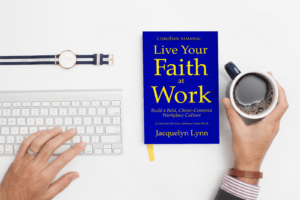
What would change if your faith shaped how you lead, decide, and treat people at work?
Live Your Faith at Work is a concise, practical guide for business owners, leaders, and professionals who don’t want their faith compartmentalized.
This Christian Business Almanac Focus book delivers clear, easy-to-apply direction for building a Christ-centered workplace culture—through leadership habits, communication, integrity, and care for people.
It’s not inspiration. It’s application.
Learn more and find purchase links at ChristianAlmanac.com.
That’s ChristianAlmanac.com.
When you write something, don’t make your readers work.
This week’s real life tip is about getting your message across clearly and making it stick.
When you’re writing—whether it’s an email, an article, marketing copy, a report, or even a book—make it easy for your readers to understand your message.
I was always taught that when I’m writing for a mass audience, I should write at the eighth or ninth grade reading level. That’s a common target for material intended for a broad audience. But I’ve learned that there are times when we might want to take that down several notches to the fourth or fifth grade level.
I’m not saying to dumb down your content. I’m saying to write in a way that lets your reader grasp your ideas, not struggle with your sentence structure.
When you write at the fifth grade level, you use short, direct sentences that usually have one main idea. You use words that most children know. At the ninth grade level, sentences are longer and more varied, with more advanced words, and they often include more than one idea.
Of course, the right reading level depends on your audience and your subject. Reading level is a guide, not a goal. Sometimes technical or specialized words are necessary. The objective is not to avoid precise language. It’s to remove complexity that doesn’t help the reader.
If your goal is to get your point across—and if it’s not, why are you writing, anyway?—but if your goal is to make a point, don’t make your reader work for it. Don’t try to impress them with your vocabulary. Use short, simple sentences and paragraphs. Use active verbs. Don’t clutter things up with a lot of unnecessary adjectives and adverbs. Give your readers solid, valuable information in a way that lets them focus on your message, not on your writing style.
And when you’re finished, read what you’ve written out loud. If you stumble over a sentence or have to read it twice to understand it, your reader probably will too.
The easier your message is to understand, the more likely your readers are to remember it—and act on it.
Thanks for being here. See you next week.