
Christian Almanac: Where Faith Meets Real Life
Episode 25 Transcript
Transcript: Don’t Make It Weird
Click on the  in each section below to read the podcast segments
Faith does not have to be forced into everyday conversations to influence them. In Episode 25 of Christian Almanac, Jacquelyn Lynn looks at how faith can shape the way we listen, respond, exercise restraint, and speak when something needs to be said.
Most of us have had moments when we knew our faith should matter in a conversation, but we weren’t sure what that should look like.
Maybe someone was discouraged, and we wanted to say something more meaningful than, “I hope things get better.” Maybe a conversation turned sharp, crude, or gossipy, and we felt that little inward check that said, Don’t join this. Maybe someone was anxious or afraid, and we wondered whether this was the moment to mention prayer, trust, or God’s faithfulness.
Then there are the moments when we worry that if we say too much, we’ll make the conversation awkward. We don’t want to sound preachy. We don’t want every interaction to feel like it’s about to turn into a sermon.
That’s a real concern. Faith should not make us awkwardly inject spiritual language into every discussion.
But we can become so careful not to force faith into ordinary conversations that we quietly keep faith out of them altogether.
Most of our conversations are not specifically religious. We talk about work. We talk about family. We talk about decisions we need to make, problems we need to solve, and the ordinary details of the day. But just because the subject is ordinary does not mean faith is absent.
Faith shapes how we enter the conversation.
It affects the way we listen, and whether we’re really paying attention or just waiting for our turn to speak. It affects our tone. It affects whether we tell the truth or exaggerate, whether we encourage someone or add to the discouragement, whether we feed fear or speak with steadiness. And it affects what we are willing to participate in — including gossip, crude humor, ridicule, or resentment.
Sometimes faith is present before we ever mention God.
Colossians 4:5 and 6 says, “Be wise in the way you act toward outsiders; make the most of every opportunity. Let your conversation be always full of grace, seasoned with salt, so that you may know how to answer everyone.” (Colossians 4:5-6, NIV)
That passage does not tell us to turn every conversation into a sermon. It points us toward wisdom in the moment. It reminds us that our words should be gracious, but not empty. Seasoned with salt, but not harsh. Thoughtful enough to fit the person, the relationship, and the situation.
That matters because people can usually tell when we are really listening to them — and when we’re using them as a setup for something we planned to say anyway.
There are times when a direct expression of faith is natural and appropriate.
If someone tells us they’re going through a hard time, we may say, “I’m sorry. I’ll be praying for you.” That’s not forcing faith into the conversation if it’s sincere and if we actually do pray.
If someone is facing a difficult decision, we may quietly ask ourselves, “What would faithfulness look like here?” And depending on the relationship, we may be able to ask that question out loud.
If someone shares good news, we may say, “That’s a blessing.” If someone is afraid, we may say, “This is hard, but we don’t have to panic our way through it.”
Those are ordinary moments. They’re simply places where faith is part of who we are.
But sometimes faith comes into conversation through restraint.
A group begins talking about someone who isn’t there, and the details get more personal than they need to be. We may not need to announce, “As a Christian, I cannot participate in gossip.” Often the more faithful response is quieter. We stop feeding the conversation. We change the subject. We say, “I don’t think we know enough to judge that.” Or we simply refuse to pass the story along.
Or maybe someone tells a crude joke, and everyone else laughs. We don’t necessarily need to say anything, but we also don’t need to pretend it was funny. There’s a kind of witness in quietly not joining what we know is wrong.
Or someone at work says, “Everybody adjusts the numbers a little.” Faith may shape our response in a very plain sentence: “I’m not comfortable doing that.”
No sermon. No drama. Just truthfulness.
That is one reason ordinary conversations matter so much. They reveal what we actually believe in the small places. When we’re annoyed. When we’re under pressure. When everyone else is laughing. When someone is hurting. When fear is spreading. When the easier thing would be to go along.
Bringing faith into ordinary conversations is not about forcing spiritual language into every exchange. It’s also not about hiding faith so carefully that no one could ever tell it shapes us.
It’s about living as one whole person.
The same faith that matters in church on Sunday matters in a Monday meeting, a call with a difficult client, a conversation with a discouraged friend, a text from a family member, or a decision about whether to repeat something we heard.
We do not have to make every conversation religious to make it faithful.
Faith may sound like compassion, courage, honesty, or restraint. It may be a sincere offer to pray, asking a better question, or making the choice to stay silent when the conversation is headed somewhere it shouldn’t go.
The point is not to manufacture moments. The point is to notice them.
Ordinary conversations are not interruptions to our spiritual life. They are one of the places our spiritual life becomes visible. Faith shapes who we are before it shapes what we say. And when faith is real, it will find its way into our listening, our tone, our choices, our restraint, and, when the time is right, our words.
When we come back, we’ll talk about those moments when faith not only shapes what we choose not to say, but gives us the courage to speak.
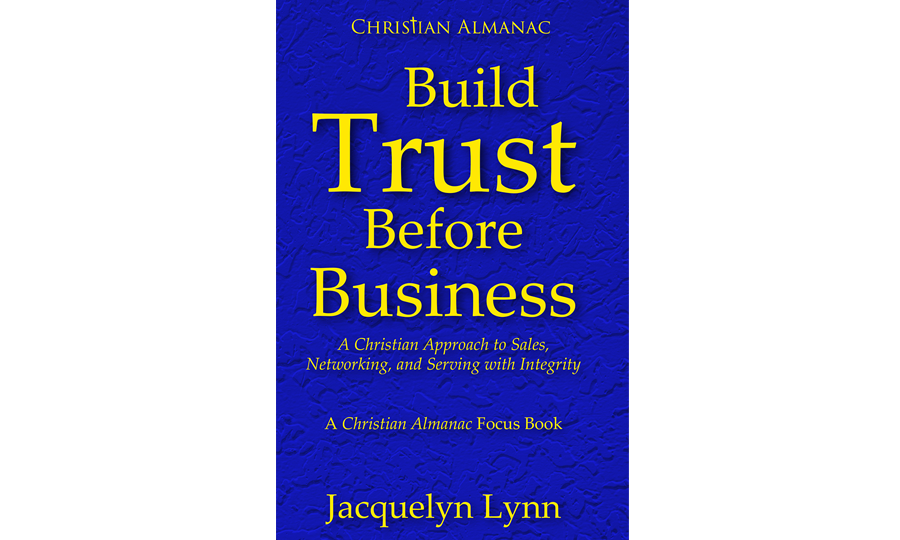
Sales and networking can sometimes make people feel as though they have to choose between growing their business and staying true to their values.
Build Trust Before Business offers another way.
This practical, faith-centered guide helps Christian professionals, business owners, entrepreneurs, salespeople, and ministry leaders approach sales and networking with honesty, wisdom, service, and respect.
Readers will learn how to explain what they offer clearly, listen before presenting, discuss price without pressure, respond to objections honestly, follow up respectfully, and build relationships that are generous rather than transactional.
Build Trust Before Business—a Christian Almanac Focus Book.
Welcome back.
There are times when staying quiet is wise. And I need to remind myself of that often.
Not every comment needs an answer. Not every opinion needs a correction. Not every tense moment needs to become a confrontation.
In the first segment, we talked about bringing faith into ordinary conversations without forcing it. Sometimes that means listening well. Sometimes it means showing restraint. Sometimes it means refusing to join gossip, crude humor, dishonesty, or fear-driven talk.
But there’s another side to this.
There are times when silence is not wisdom. It’s avoidance.
We may tell ourselves we’re being patient. We may say we don’t want to judge. We may decide it’s not our place to speak. And sometimes that’s true. But sometimes those phrases become a way to avoid the discomfort of saying what needs to be said.
These situations have happened to all of us.
Someone is being treated unfairly, and everyone looks away.
A friend is making a destructive decision, and we keep telling ourselves, “She has to live her own life and deal with the consequences.”
A conversation turns dishonest, and we let it continue because correcting it would be awkward.
A child, employee, friend, or family member needs a hard truth, and we stay quiet because we don’t want the tension that may follow.
Faithfulness does not require us to correct everything we hear. But it does require us to be honest about why we are silent.
Ephesians 4:15 says,
“Instead, speaking the truth in love, we will grow to become in every respect the mature body of him who is the head, that is, Christ.” (Ephesians 4:15, NIV).
Speaking the truth in love holds two responsibilities together.
Truth without love can become harsh, careless, or self-righteous. We may say the right thing in the wrong tone, wrong place, or wrong time, and then excuse it by saying, “Well, it was true.”
Love without truth can become weak or dishonest. It can look kind on the surface while refusing to offer what someone needs most.
Faithful speech needs both.
Before we speak, we may need to ask: Is this true? Is it loving? Is it mine to say? Is this the right time? Have I listened first? Am I trying to help, or am I trying to win?
Those questions matter because being right does not automatically mean speaking is wise. But being uncomfortable does not automatically mean silence is wise either.
The goal is not to win the moment. The goal is to be faithful in the moment.
Most of the time, faithful words do not need to be dramatic. They don’t need to be loud. They don’t need to sound like a speech.
They may sound like this:
“I don’t think we’re being fair to the person who isn’t here.”
Or, “I care about you, and I’m concerned about where this may lead.”
Or, “I’m not comfortable presenting it that way.”
Or, “I understand why you’re frustrated, but I don’t think this is the right way to handle it.”
Simple words can be strong words when they are true, gracious, and timely.
The time and place of when you speak is as important as the words. Sometimes the most faithful words are said in private. Public correction may embarrass someone or harden the conversation. A private word may be easier to receive. It gives the other person room to think instead of react.
This is especially important when the relationship matters. A faithful friend does not correct everything. But a faithful friend is also not content to watch someone walk toward harm and say nothing.
Being courageous doesn’t mean being controlling. Being truthful doesn’t mean being critical. And refusing to participate in something wrong is not the same as starting a fight.
We will not always get this right. Sometimes we’ll speak when we should have waited. Sometimes we’ll stay quiet and later realize we should have said something. That’s part of learning wisdom.
But we can grow in this. We can become people whose words are neither careless nor cowardly. People who are not looking for arguments, but who are also not afraid of truth. People who speak with grace, not with avoidance.
Faith does not require us to comment on everything, correct everyone, or turn every disagreement into a confrontation.
But there are times when love requires words. Truth requires words. Responsibility requires words.
And when that moment comes, the goal is not to be loud, clever, or forceful.
The goal is to be faithful — with words that are true, gracious, timely, and shaped by love.
I’ll be back in a moment with this week’s real life tip.

If you spend your days making decisions, solving problems, and carrying responsibility, you also need moments that restore you.
Not more input. Not more strategy. Just quiet focus.
Christian Meditations pairs detailed illustrations with biblically grounded reflections—creating space to slow your thoughts and center your heart.
And Faith Words: Color the Words that Inspire You Every Day invites you to sit with one meaningful word at a time—coloring it in as you let its truth settle in.
A simple practice. A steady rhythm. Faith that meets real life—even in the quiet moments.
Available on Amazon or at your favorite bookstore.
A few years ago, I was at a book signing event and a woman came up to our booth and greeted me by name. She looked vaguely familiar, but I couldn’t place her. I guess it showed on my face, because she said, “You don’t remember me, do you?”
I apologized. Then she said, “Well, I’m not going to tell you who I am. You’re just going to have to figure it out.” And she planted herself firmly in front of my book display.
After some back and forth, she finally gave me some hints, and I remembered that I knew her very casually from a business group I’d been in several years before. I pretended to be delighted to see her, but the reality was, I was frustrated and annoyed. I hadn’t seen her in years, and our relationship hadn’t been particularly close, so it wasn’t surprising that in an environment totally different from where we had known each other, I couldn’t remember who she was.
So here’s the tip: If you find yourself in a situation where you encounter someone who seems to be having trouble remembering you or your name, help them out. Tell them who you are. Remind them of how you know each other. Don’t put them in the uncomfortable position of having to admit that they don’t remember.
If the person is someone you’ve only met a few times, be proactive about giving your name and reminding them of how you know each other. Greet them and say something like, “Hi, I’m Jacquelyn Lynn. We met at the chamber lunch a few months ago.”
Nobody likes to think they’re forgettable. But at the same time, we don’t need to embarrass someone over a memory lapse. So be gracious. And that will likely make you very memorable in a positive way.
Thanks for being here. See you next week.