
Christian Almanac: Where Faith Meets Real Life
Episode 19 Transcript
Authenticity, AI, and the Wisdom to Engage
Click on the  in each section below to read the podcast segments
In this episode, Jacquelyn Lynn talks about authentic faith in a performative world, biblical integrity, discernment, and the wisdom Christians need when engaging artificial intelligence.
“Authentic” has become one of those words we hear everywhere.
We’re told to be our authentic selves, lead authentically, build authentic relationships, communicate authentically, and show up authentically.
And that sounds good.
But like a lot of good words, it can lose meaning when it becomes a slogan.
Sometimes when people say, “I’m just being authentic,” what they really mean is, “I’m going to say whatever I think, do whatever I feel, and you’re not allowed to challenge me.”
That’s not authenticity. That’s self-protection with better branding.
So what does it really mean to be authentic?
For followers of Christ, the better question may not be, “Am I being authentic?”
The better question may be, “Am I being truthful, faithful, and consistent before God and others?”
Because biblical authenticity is not simply about expressing ourselves. It’s about integrity.
It means there’s alignment between what we believe, what we say, what we do,
and who we are becoming in Christ.
It’s not, “This is just who I am, so everyone else has to deal with it.”
It’s more like, “This is who I am before God, and this is who he is shaping me to become.”
That’s an important distinction.
Authenticity is not permission to say every thought out loud.
It’s not a spiritual-sounding way to defend impatience, harshness, selfishness, or immaturity.
And it’s not the same thing as transparency.
Transparency may mean I tell you what I’m feeling or what I’m struggling with.
Authenticity means I’m not pretending to be something I’m not.
Those can overlap, but they are not identical.
A person can be very transparent and still be performing.
And a person can be quiet, private, and reserved and still be deeply authentic.
So was Jesus authentic?
Yes. Perfectly.
Jesus was never false. He was never divided. He was never performing for approval.
He could be tender with the broken. He could be direct with the self-righteous. He could be silent before false accusation. He could be bold when truth required it.
He didn’t adjust his message to impress the powerful. He didn’t flatter people who needed correction. He didn’t crush people who needed mercy.
In John 14:6, Jesus says, “I am the way and the truth and the life.” (John 14:6, NIV)
Jesus did not merely speak truth. He embodied truth.
And in John 8:29, he says, “The one who sent me is with me; he has not left me alone, for I always do what pleases him.” (John 8:29, NIV)
That’s perfect alignment.
His words, his actions, his motives, and his obedience were completely whole.
Jesus shows us that authenticity is not self-expression at any cost.
It’s truth lived without hypocrisy.
What about the disciples? Were they authentic?
Yes, but not perfectly.
And I think that matters. I find it comforting.
The disciples are not presented in Scripture as polished heroes. Far from it.
We see their fear, confusion, ambition, questions, failures, and growth.
Peter is one of the clearest examples.
Before Jesus was arrested, Peter insisted he would never fall away. But when the pressure came, Peter denied knowing Jesus—and he did it three times.
That was a serious failure, but Scripture doesn’t hide it.
And after the resurrection, in John 21, Jesus restores Peter.
Jesus asks him, “Do you love me?” three times.
And then he gives Peter responsibility: “Feed my sheep.”
Peter was not authentic because he always got it right.
He was authentic because he was brought face-to-face with the truth, and he did not remain hidden behind his failure.
He was restored. He was changed. He moved forward.
That’s biblical authenticity.
It doesn’t mean we never fail. It means we stop hiding.
It means we bring the truth before God and allow correction, repentance, forgiveness, and growth to become part of our story.
So how do we know if we’re being authentic?
Start with alignment. Ask yourself:
Is there alignment between my public words and my private choices?
Do I speak one way about faith, integrity, patience, generosity, humility, or trust, but live differently when no one is watching?
Another question is: Am I honest without being self-indulgent?
Authenticity does not mean I have to disclose everything to everyone.
Wisdom still matters. Boundaries still matter. Timing still matters.
Proverbs 12:23 says, “The prudent keep their knowledge to themselves, but a fool’s heart blurts out folly.” (Proverbs 12:23, NIV)
Being authentic doesn’t mean we say everything we think or feel without any filters.
It means what we do say is truthful.
Another question is: Am I willing to be corrected?
A person who is truly authentic doesn’t have to protect a false image.
They can say, “I was wrong.” “I need help.” “I need to grow.”
That kind of honesty isn’t weakness. It’s maturity.
And one more question: Am I becoming more like Christ, or just more comfortable defending myself?
Because sometimes what we call authenticity is really resistance to growth.
We say, “This is just how I am.”
But the Holy Spirit may be saying, “Yes, and that is exactly where I want to work.”
Now, how do we know if other people are being authentic?
We have to be careful here. We can’t fully know another person’s heart. Only God sees perfectly.
But we can look for patterns.
Do their words and actions match over time?
Do they take responsibility when they’re wrong?
Do they tell the truth even when it costs them?
Do they treat people well when there’s nothing to gain?
Do they show humility?
Do they become defensive every time accountability appears?
In Matthew, Jesus said, “By their fruit you will recognize them.” (Matthew 7:16, NIV)
Fruit takes time to see. And that’s why we look for patterns.
We also have to remember that authenticity is not the same as charisma.
A person can be warm, funny, emotional, expressive, and transparent—and still not be trustworthy.
And a person can be calm, quiet, reserved, and careful—and still be deeply trustworthy.
So don’t evaluate authenticity only by how much someone shares.
Look at the fruit.
Look at consistency.
Look at humility.
Look at whether their private conduct seems to match their public claims.
For ourselves, the question is not, “How do I seem more authentic?”
That can become just another performance.
The better prayer is:
“Lord, make me whole. Make me truthful. Make me faithful. Close the gap between what I say I believe and how I actually live.”
Because authenticity is not about putting more of ourselves on display.
It’s about living with integrity before God.
Real authenticity is not simply being true to yourself.
It’s being truthful before God—and letting him shape who you are.
When we come back, we’ll discuss how that same commitment to truth, wisdom, and responsibility should shape the way we engage with artificial intelligence.
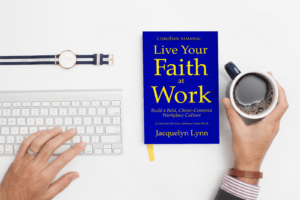
What would change if your faith shaped how you lead, decide, and treat people at work?
Live Your Faith at Work is a concise, practical guide for business owners, leaders, and professionals who don’t want their faith compartmentalized.
This Christian Business Almanac Focus book delivers clear, easy-to-apply direction for building a Christ-centered workplace culture—through leadership habits, communication, integrity, and care for people.
It’s not inspiration. It’s application.
Learn more and find purchase links at ChristianAlmanac.com.
That’s ChristianAlmanac.com.
Welcome back.
Artificial intelligence is no longer a future issue.
It’s here.
People are using ChatGPT, Claude, Gemini and other AI tools to write emails, summarize information, brainstorm ideas, create images, plan projects, analyze data, prepare lessons, write code, and make decisions faster. Other AI tools are being used to provide customer service and manage sales funnels. And that’s just the tip of the iceberg.
Some people are excited about it.
Some are uneasy.
Some are overwhelmed.
And some are trying to pretend it’s not happening.
But the proverbial AI genie is out of the bottle.
AI has been around in different forms for years, and now it’s moved into everyday life in a way most people can see and use.
So the question is not whether AI will affect our lives, our work, our churches, our families, and our businesses.
It already is.
The better question is: How will we engage with it wisely?
I recently read Danny Iny’s book, AI Curious, and one of the things I appreciated about it is that he does not treat AI as simply a content machine.
That’s how a lot of people think about it. They think of AI as something that writes a social media post, drafts an email, or gives them a quick answer to a question.
And yes, it can do those things.
But Iny teaches something much more useful. He explains how to use AI as a strategic partner, not simply a content generator.
Because if we only use AI to crank out more words, more posts, more messages, and more noise, we may become more efficient without becoming more thoughtful.
But when we use AI as a strategic partner, we can ask better questions.
We can test ideas. We can examine options. We can think through consequences. We can clarify what we’re really trying to accomplish.
In AI Curious, Iny also points out something important that we need to keep in mind. Throughout history, every major technological advancement has produced chaos alongside opportunity.
When we’re living through disruption, we tend to notice the chaos first. But let’s look at some life-changing advancements through the lens of perfect hindsight.
The printing press disrupted who could access information and who could distribute ideas.
Industrialization changed how people worked, where they lived, how businesses operated, and how communities developed.
The internet transformed communication, publishing, commerce, education, research, entertainment, and personal connection. I often talk about how different it is to write articles and books today than it was when I began my professional writing career.
Each advancement opened doors that previous generations could hardly imagine. Each also brought problems.
The internet, for example, gave us access to enormous amounts of information, but it also brought misinformation, distraction, privacy concerns, and a level of noise we’re still learning how to manage.
Not a single one of those transitions was neat. Not one was painless. Not one was purely good in every way.
And none of them could be put back in the bottle.
AI is following that same larger pattern.
It brings disruption. It brings opportunity. It brings ethical questions. It brings temptation.
And it brings responsibility. So we need to be honest about both sides.
We shouldn’t minimize the concerns.
AI raises real issues about accuracy, privacy, plagiarism, authorship, bias, job disruption, dependence, and deception.
It can make a false statement sound confident.
It can make borrowed ideas look original.
It can encourage people to cut corners.
It can create work that looks polished but has very little wisdom behind it.
That concerns me, and it should concern you.
But concern is not the same as panic.
And caution is not the same as refusal.
In some ways, we can compare IA to rip currents in the ocean. Rip currents are narrow channels of fast-moving water that travel away from the shore, and they’re the leading cause of ocean rescues. We live in Florida, and I grew up here. All my life I’ve been reminded of what you should do if you get caught in a rip current: Don’t panic and don’t fight it. Don’t try to swim straight back to shore. Instead, swim parallel to the beach until you’re out of the rip current.
So if technology is the ocean, sometimes AI can feel like a rip current. It’s powerful and you’re afraid you’re going to drown in it. But if you don’t panic, you can get past the rip current and move to a place where you can enjoy the ocean.
For Christians, the goal is not to worship technology, fear technology, or ignore technology.
The goal is to exercise wisdom as we use technology.
Proverbs 4:7 says, “The beginning of wisdom is this: Get wisdom. Though it cost all you have, get understanding.” (Proverbs 4:7, NIV)
That’s a strong reminder for this moment.
Most of us will never understand all the technical details behind AI. We don’t need to, and I certainly don’t want to.
What we need is wisdom.
We need enough understanding to engage carefully.
We need enough discernment to know when to use it, when not to use it, when to verify, and when to step back.
Some people may say, “I’m just not going to use AI.” What they really mean is they’re not going to use platforms like ChatGPT and Claude, because we’re all using AI and we have been for years—we just thought of it as technology.
In certain situations, refusing to use certain AI tools may be a valid boundary.
There may be tools you choose not to use.
There may be tasks you decide should remain entirely human.
There may be information you should never put into an AI system.
Those are wise limits.
But as a broad posture, simply ignoring AI is not realistic.
AI is already built into search engines, phones, business software, online shopping, social media feeds, fraud detection, customer service systems, financial tools, and writing tools.
We’re already engaging with AI. The question is whether we are doing it consciously.
The choice is NOT AI or no AI.
The choice is passive exposure or wise engagement.
So what does wise engagement look like?
First, use AI as a tool, not an authority.
AI can help us brainstorm, summarize, organize, compare, and draft.
It can help us see options we may have missed.
It can help us think through strategy.
But it should not replace wisdom, conscience, prayer, expertise, or human responsibility.
AI can assist our thinking. It should not do our thinking for us.
Second, verify what matters.
AI can be wrong. So when accuracy matters, we have to take the time to verify.
Speed is useful, but truth is essential.
Third, protect what should remain private.
Don’t put confidential, sensitive, proprietary, or deeply personal information into AI tools unless you understand how that information may be used, stored, or shared, and you have confidence that your information will be protected.
You may be tempted to tell your AI tool something you shouldn’t because you want a quick answer, but convenience is not worth the cost of carelessness.
Fourth, don’t use AI to deceive.
Don’t use it to pretend you created something you didn’t. Don’t use it to fake expertise.
And especially don’t use it to manipulate people.
AI may help us communicate, but we shouldn’t ask it to help us misrepresent ourselves. Although I admit that I’ve asked AI to help me write a tactful message when I was not in the mood to be diplomatic.
And fifth, let AI support your calling, not replace your responsibility.
For entrepreneurs, leaders, writers, teachers, pastors, parents, and professionals, AI can be genuinely useful.
It can help us get unstuck. It can organize scattered thoughts. It can help small teams do work that used to require more time or money.
But it can’t carry the calling.
It can’t love people for us.
It can’t obey God for us.
It can’t replace character.
It can’t replace discernment.
So don’t ask, “Is AI good or bad?” Think about how we’re using it.
Are we using it to serve better?
To help us think more clearly?
To steward our time more faithfully?
Or are we using it to avoid responsibility, cut corners, impress people, or create more noise?
AI is here.
It’s been here in some form for years.
And it will continue to grow.
For followers of Christ, the call is not panic, and it’s not blind adoption.
The call is wisdom.
Use the tools available. Ask better questions. Verify what matters. Protect people. Tell the truth. Refuse deception.
And remember that no technology, no matter how advanced, removes our responsibility before God.
The AI genie may be out of the bottle.
But wisdom is still our responsibility.
I’ll put a link to Danny Iny’s book in the description. It’s a worthwhile read. And I’ll be back in a moment with this week’s real life tip.
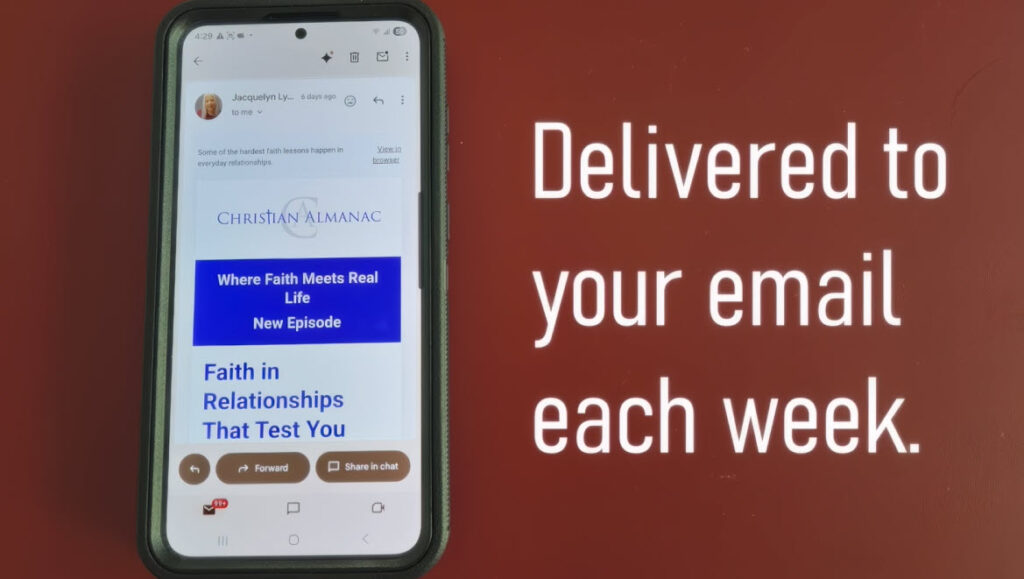
If you’re serious about integrating faith into the decisions you make every day, don’t leave it to chance.
Join the Christian Almanac email list, and each new episode will be delivered to your inbox as soon as it’s released.
No extra effort. Just clear, consistent input when it matters most.
You’ll also receive Shareable Saturday—concise insights you can apply immediately or share with your team.
Sign up at ChristianAlmanac.com/connect
This week’s real life tip is half tip and half rant.
Before you share a file with someone, think about the file name. Can the person you’re sending that file to tell what the file is without opening it?
One of the ways I serve the U.S. Christian Chamber of Commerce is as the publication and content advisor. Part of that involves screening articles for the newsletter submitted by guest authors. I’ve gotten Word files named “newsletter article” and image files named “headshot” or even “myheadshot”. Those files go through a number of hands before they finally appear in the newsletter, so it’s important that everyone who gets them knows exactly what they contain.
I change the names of the files when I download them, and it only takes me a few seconds to do it, but when I get files like that, I have to wonder about the experience and professionalism of the sender.
So this is the tip: Before you send a file to anyone for any reason, make sure the file name clearly indicates what the file is. If it’s an article, include the title and your name. If it’s an image, describe the image. If it’s something else, maybe a report, a proposal, an invoice, a contract, a resume, a presentation, or meeting notes, name the file appropriately. Don’t risk having your files get lost in someone else’s system because they can’t be identified.
A clear file name is a small thing, but it shows professionalism on your part as well as respect for the person receiving it—and it makes you easier to work with.
Thanks for being here. See you next week.