
Christian Almanac: Where Faith Meets Real Life
Episode 15 Transcript
When Trust Breaks and Truth Gets Blurred
Click on the  in each section below to read the podcast segments
Why are we so quick to judge someone’s life by the worst thing they’ve done instead of the best?
I’m not talking about people who personify evil—people like Jeffrey Dahmer or Ted Bundy. I’m not even talking about people who routinely lie, cheat, and steal.
I’m talking about normal—if there really is such a thing—normal people, maybe even wealthy or well-known people, people who have regular lives, with families and careers, who do a lot of good but have also done things that are wrong.
We see it in the world of celebrities and politicians all the time. Not the kind of cancel culture where someone says something that half the population disagrees with and they’re viciously attacked for it, but a lapse in judgment that causes a failure in conduct. And suddenly nothing else they’ve ever done matters.
Is it right to let one failure, one lapse in judgment, outweigh a lifetime of good? Or is that exactly what integrity requires?
Because we’ve all seen it.
Someone builds a meaningful life. They have a family. They contribute to society. They give generously. They’re reliable and consistent.
And then one moment—one decision, one action, one failure—and suddenly, that’s what defines them. Nothing else matters.
But should it? Shouldn’t everything else they’ve done count for something?
When I first started thinking about this, I was coming at it from the angle that maybe we need to be more forgiving, more willing to balance the good with the bad.
And maybe we do. But I also understand why we react the way we do.
It’s because when trust is broken, especially by someone we respected, it doesn’t feel like a small thing. It feels like something fundamental shifted.
Not just WHAT THEY DID—but WHO THEY ARE.
And that’s the tension.
On one hand, we want to say:
A lifetime of good should matter.
On the other hand, we know:
Integrity isn’t measured over time—it’s revealed in moments.
So which is it?
I think the answer is: both. And that’s what makes this hard.
A lifetime of good does matter. It’s real. It has impact. It changes lives. That doesn’t disappear because of one failure.
But a failure—especially one that breaks trust—also matters in a different way.
Because trust isn’t built the same way as achievement.
You can build a business, a reputation, a body of work over years. You can be a great person or an absolute jerk and still achieve things.
But trust is different from achievement. Trust is something people place in you. And once it’s broken, they don’t go back and average your behavior. They reassess everything.
That’s not always fair. But it’s reality.
When someone shows us something that contradicts what we believed about them, we don’t just file it away. We start asking questions.
Was that generosity real?
Was that leadership authentic?
Was that expression of faith genuine?
And sometimes those questions go further than they should.
Sometimes we erase the good too quickly. And we can be pretty self-righteous about it.
Scripture doesn’t let us pretend human failure is rare. Ecclesiastes 7:20 says
Not a single person on earth is always good and never sins. (Ecclesiastes 7:20, NLT)
That verse doesn’t excuse sin. It simply reminds us that none of us should stand too comfortably in the seat of judgment.
But maybe, instead of passing judgment on others, we can use their failures as an opportunity for some honest self-examination. Rather than looking at their story, we look at our own.
Because what’s really happening here isn’t only about how we judge other people, it’s also about how WE live.
If you’re building something—your work, your influence, your reputation—you’re not just building results. You’re building trust.
And trust doesn’t grow from what you do occasionally.
It grows from who you are consistently.
Luke 16:10 says it simply:
If you are faithful in little things, you will be faithful in large ones. But if you are dishonest in little things, you won’t be honest with greater responsibilities. (Luke 16:10, NLT)
That’s not about performance. That’s about integrity.
It’s about alignment between what we say, what we do, and who we are when no one is watching.
Proverbs 10:9 puts it this way:
Whoever walks in integrity walks securely, but whoever takes crooked paths will be found out. (Proverbs 10:9, NIV)
So the question isn’t really:
Is it fair that one failure can outweigh a lifetime of good?
The better question is:
Am I living in a way where my character can withstand that kind of scrutiny?
Because none of us is perfect.
We all make mistakes. We all have moments we wish we could take back.
But there’s a difference between a mistake and a breach of trust.
A mistake is something you do.
A breach of trust is something that reveals a gap between who you present yourself to be and who you actually are.
And that gap is where reputations break.
It’s not that we’re unforgiving. It’s that trust depends on consistency.
So now that I’ve answered my question about why we’re so quick to judge someone’s whole life by the worst thing they’ve done, what do we do with this?
First, let’s be intentional about holding a balanced view of others. Don’t ignore the good someone has done. That matters. But don’t ignore the reality of broken trust. Both can be true at the same time.
Second, when it comes to ourselves, take what you’ve done personally, but in the right way. Not with fear or pressure, but with awareness. The goal isn’t to protect your reputation, it’s to live with integrity.
Remember, reputation is what people say about you. Integrity is what God knows about you. Let your reputation and your integrity align.
Don’t worry about people judging you if you fail. Instead, ask:
“Am I building a life where what’s seen and unseen match?”
Because that’s what lasts.
That’s what holds.
That’s what allows your work, your influence, and your faith to stand, not just when things are going well, but when they’re tested.
I’ll be back in a moment to talk about why polls deserve more scrutiny than trust.
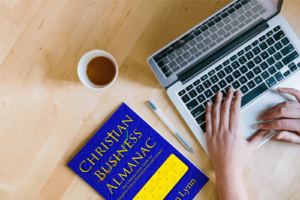
Most leaders don’t struggle with believing—they struggle with applying.
Christian Business Almanac bridges that gap.
This page-a-day resource brings Scripture, wisdom, and practical perspective into the real decisions you face at work and in leadership—day after day, all year long.
No fluff. No shortcuts. Just steady, biblical guidance for people who want their faith fully integrated with how they lead, work, and live.
Discover more and find purchase links at ChristianAlmanac.com.
That’s ChristianAlmanac.com.
Welcome back.
How often have you looked at the results of a poll and either felt validated because the majority of people surveyed agree with you or invalidated because they don’t?
The thing we need to keep in mind about polls is that many of the ones we hear about are designed to mold public opinion, not report on it.
Of course, if an organization commissions a poll and it doesn’t like the results, it’s under no obligation to release them. For example, if a retailer does a poll and finds out that 60 percent of their target market thinks they’re doing a lousy job in some area, it would be wise to keep the poll confidential and simply fix the problem.
But I’m talking about polls about candidates and issues. Voters look at polling results as one source of information when they’re making up their minds. And some will switch sides based on polling results.
A Stanford Business working paper explained it this way:
“Psychologists have long observed that people conform to majority opinion, a phenomenon sometimes referred to as the “bandwagon effect.” In the political domain people learn about prevailing public opinion via ubiquitous polls, which may produce a bandwagon effect. Consequently, polls and probabilities can become self-fulfilling prophecies whereby majorities, whether in support of candidates or policies, grow in a cascading manner.”
So if I see a poll that says 75 percent of people feel a certain way, and I don’t, I wonder if maybe I need to reexamine my position. Maybe I’m missing something.
But another part of this is how the questions are phrased.
In my city, there’s a group of local political activists who have been doing polls for years. These are amateur pollsters and, especially in the beginning, they weren’t very good at hiding the results they were trying to get. Their questions were very much in the style of “When did you stop beating your wife?”
They’ve gotten a little smoother, but there’s still an obvious slant to everything they do.
When it comes to asking biased questions, more sophisticated pollsters do a much better job at hiding their agenda. A lot of thought goes into constructing polls. Biased pollsters craft their questions in a way that’s designed to generate the answer they want. They use emotional language. They might frame their questions to highlight only one side of an issue. They order the questions carefully to provide a context that’s more likely to deliver the results they want.
Another trick biased pollsters use is to force binary choices. They might offer only yes or no as options to a question about a nuanced topic, and that forces respondents to pick a side they might not fully support.
For example, instead of asking, “What concerns, if any, do you have about this proposal?” they might ask, “Do you support this proposal, yes or no?” That removes the space for someone to say, “I support the goal, but I’m concerned about the cost” or “I agree with part of it, but not all of it.”
Or they ask two-in-one questions, so you have to give one answer for both, but your answer might not be the same for both.
A question might ask, “Do you support improving public safety and expanding surveillance in neighborhoods?” Well, you might strongly support public safety but have serious concerns about expanded surveillance. By blending the two issues together, the answer can be used in a way that may not accurately reflect what the respondent believes.
Or they might try to manipulate respondents by feeding them negative information under the guise of a poll.
That can sound something like, “If you knew Candidate Smith had voted against funding for local services, would that make you more or less likely to support him?” The respondent may not know whether that statement is complete, fair, current, or even relevant, but now the negative idea has been planted. That’s not simply measuring opinion. That’s shaping it.
Then, when the pollster gets the results that support their position, they release the poll and watch for the bandwagon effect to happen.
This is why discernment matters. A poll may tell us something useful, but it may also tell us more about the person or organization asking the questions than it tells us about public opinion.
Another issue to consider when evaluating poll results is the size and make-up of the sample. Who is actually responding? How many people were surveyed? Were they likely voters, registered voters, adults in general, members of a particular organization, or people who chose to respond online?
A poll of 500 carefully selected likely voters may be more useful than a much larger poll of people who opted in because they already had strong feelings about the issue.
I have no evidence for this, but I think the internal polling done by political campaigns and other interests, the polling that’s rarely, if ever, released to the public, is actually less biased and more accurate because those organizations need to know how people really feel so they can plan their strategies.
That doesn’t mean internal polls are perfect. It simply means their purpose is different so they might be constructed differently. A campaign that wants to win needs information that’s useful, not just flattering.
I’m not suggesting you ignore polls. They can have value and at the very least, they can be interesting. But don’t accept them at face value.
Proverbs 18:17 says, “The first one to plead his cause seems right, until his neighbor comes and examines him.” (Proverbs 18:17, NKJV)
That’s a good reminder for far more than courtroom testimony. The first number we hear, the first headline we see, the first poll result that confirms what we already believe may seem right—until we examine it more carefully.
And 1 Thessalonians 5:21 gives us this simple instruction: “Test all things; hold fast what is good.” (1 Thessalonians 5:21, NKJV)
Don’t let a poll do your thinking for you. Read it carefully. Ask who paid for it. Look at how the questions were asked, who was surveyed, and what information may have been left out. Then test what you’re hearing against truth, wisdom, and the character of God—not the pressure of the crowd.
I’ll be back in a moment with this week’s real life tip.

If you’re listening to the Christian Almanac podcast, here’s a simple way to stay connected.
Join the email list, and every new episode will be sent straight to your inbox as soon as it’s available.
No searching. No wondering if you missed one.
Just a clear, timely update when a new episode is ready.
You’ll also receive Shareable Saturday, short meaningful messages you can read, reflect on, or pass along.
Sign up at ChristianAlmanac.com/connect
If you’re on Facebook, you probably know that it gives you a notification every day of your friends who have birthdays. I appreciate that. But occasionally, one of the people on a particular day’s list has died. Sometimes recently. Sometimes years ago. And there are usually some people on their friend list who continue to send birthday wishes. I think that’s creepy. But it’s not exactly what this week’s real life tip is about. The tip is this:
We all need a plan for what happens to our online accounts when we die. Not just social media, but everything.
It’s called digital legacy planning.
If you don’t do it, your loved ones may be locked out of your financial accounts, they may get stuck paying for subscriptions they can’t cancel, and they may be unable to access precious photos or important files.
You need a plan that covers everything you do online. Do a search on “digital legacy planning” and you’ll get plenty of instructions for how to set up your plan. It probably won’t take more than an afternoon to do, and it will save your loved ones countless hours of frustration and expense when you die.
It’s one of those simple, thoughtful things you can do now as an act of love for the people who will someday have to handle what you leave behind.
Thanks for being here. See you next week.