
Christian Almanac: Where Faith Meets Real Life
Episode 14 Transcript
You Can’t Remove Every Weed—But You Can Choose How You Live
Click on the  in each section below to read the podcast segments
How do you live out your faith when you’re surrounded by things you know aren’t right?
Maybe it’s a difficult coworker.
Maybe it’s a workplace culture that doesn’t reflect your values.
Maybe it’s a situation you can clearly see—but you don’t have the authority or the ability to fix, and you either can’t or don’t want to walk away.
That tension can wear on you. And if you’re not careful, it can begin to shape how you respond.
Jesus addressed this directly—not by promising us a clean, perfect environment, but by explaining the reality we live in.
In Matthew 13 (verses24–30), he tells the parable of the wheat and the weeds.
A farmer plants good seed in his field. But while everyone is asleep, an enemy comes in and sows weeds among the wheat. When the plants begin to grow, the servants notice the problem and ask the obvious question: “Do you want us to go and pull up the weeds?”
It sounds like the right response. Fix the problem. Clean it up.
But the farmer says no.
He tells them to let both grow together until the harvest—because pulling up the weeds too soon could damage the wheat.
That’s not the answer they expected. And it’s not always the answer we want, either.
Because we want a clean field.
We want to fix what’s wrong.
We want to remove what doesn’t belong.
We want clarity, fairness, and resolution—and we want it now.
But Jesus is telling us something important: there will always be weeds in the field.
Not just “out there” somewhere—but right alongside the good plants, the plants we want and need.
There is no completely weed-free environment. Not at work. Not in relationships. Not in the world we live in.
And when we expect one, we set ourselves up for constant frustration.
So the question isn’t, “Why are there weeds?”
The question is, “How do I live faithfully in a field that has them?”
One of the first things this parable shows us is that not every problem is ours to fix.
The servants were ready to act immediately. They saw the issue, and they wanted to correct it.
But the farmer restrained them.
Not because the weeds didn’t matter—but because the timing and the method mattered.
If you’re in a leadership role, this matters even more. Not every issue requires immediate action. Some require discernment, timing, and restraint.
And that’s where this becomes very practical for us.
There are people you will not be able to change and situations you will not be able to control—at least not right now.
And trying to force change in those moments can sometimes do more harm than good.
It can damage relationships.
It can create unintended consequences.
And it can distract you from what you are actually responsible for.
For example, you may be working or volunteering in an environment where corners are cut or standards are lower than you believe they should be. You see it clearly. You know how it could be done better. And part of you wants to step in and fix all of it.
But if you push too hard or move too fast, you risk damaging relationships, losing influence, or even undermining your ability to do the work you’ve been called to do.
That doesn’t mean you ignore the problem. It means you approach it with wisdom—choosing where to speak, when to act, and where to focus your responsibility.
This isn’t about overlooking what’s wrong—it’s about responding with discernment.
James 1:19 reminds us, “Everyone should be quick to listen, slow to speak and slow to become angry” (James 1:19, NIV). That kind of restraint isn’t weakness—it’s wisdom.
Because trying to uproot every weed can damage what God is growing.
So if we can’t control the entire field, what can we control?
That brings us to the next point: you are responsible for your soil.
In the middle of a field that contains both wheat and weeds, your focus has to shift inward.
Your character.
Your integrity.
Your spiritual health.
Proverbs 4:23 says, “Above all else, guard your heart, for everything you do flows from it.” (Proverbs 4:23, NIV)
That matters even more—or maybe especially—when you’re surrounded by things that aren’t right.
Because it’s easy to let weeds take root in you.
When they do, cynicism can creep in.
Frustration can turn into bitterness.
You can start mirroring the very behavior that bothers you.
And when that happens, the weeds aren’t just around you anymore—they’re in you.
So part of living faithfully in a mixed field is making a deliberate decision:
I’m not going to let what’s around me determine who I become.
I’m going to stay rooted in truth.
I’m going to act with integrity.
I’m going to do the work I’ve been given to do—faithfully and well.
This is what it means to be IN the world but not OF the world.
Galatians 6:4–5 reminds us to pay attention to our own work and our own responsibility. That’s where your focus belongs.
And then there’s one more piece of this that requires trust.
In the parable, the separation of the wheat and the weeds doesn’t happen immediately. It happens at the harvest.
In other words, there is a right time for things to be made clear and set right—but it’s not always now.
That requires patience and trust.
Trust that God sees what we don’t.
Trust that nothing is overlooked.
Trust that justice and clarity will come—even if they don’t come on our timeline.
This isn’t passivity or indifference. It’s faithful restraint paired with wise action where you are actually called to act.
And that’s how we live in a field that contains both wheat and weeds.
So here’s how you can put this into practice:
First, adjust your expectations.
Stop waiting for a perfect environment to live out your faith. It doesn’t exist.
Second, focus your responsibility.
Ask yourself: what has God actually entrusted to me in this situation? That’s where your energy belongs.
And third, guard your heart and your habits.
Stay rooted in truth. Don’t let what surrounds you shape your character.
The presence of weeds doesn’t mean something has gone wrong.
It means you’re living in the world Jesus described.
And faithfulness isn’t proven in perfect conditions—it’s proven in mixed fields.
You don’t need a perfect field to live out your faith.
You need a steady one.
You need the wisdom to tend what God has placed in your care—and the steadiness to do it well.
When we come back, we’ll talk about how to choose your work—and the people you work with—wisely.
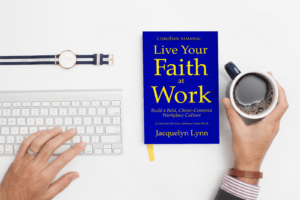
What would change if your faith shaped how you lead, decide, and treat people at work?
Live Your Faith at Work is a concise, practical guide for business owners, leaders, and professionals who don’t want their faith compartmentalized.
This Christian Business Almanac Focus book delivers clear, easy-to-apply direction for building a Christ-centered workplace culture—through leadership habits, communication, integrity, and care for people.
It’s not inspiration. It’s application.
Learn more and find purchase links at ChristianAlmanac.com.
That’s ChristianAlmanac.com.
Have you ever said yes to a project or a client—and almost immediately regretted it?
It looked like a good opportunity.
You needed the business.
It seemed manageable.
But once you got into it, something wasn’t right.
The expectations weren’t clear.
The communication was difficult.
The work wasn’t a good fit—or the person wasn’t.
And before long, what looked like an opportunity started draining your time, your energy, and your focus.
So here’s the question:
What if the issue isn’t how much you’re doing—but whom you’re doing it with?
We spend a lot of time thinking about what work we should take on.
But we don’t always think carefully about who we should work with.
And that decision shapes everything.
One of the most important disciplines you can develop—in your work and in your life—is learning that you don’t have to say yes to everything.
You don’t have to accept every client.
You don’t have to take every project.
You don’t have to pursue every opportunity that comes your way.
Because more work is not always better work.
Sometimes it’s just more noise, more stress, and more distraction from what you’re actually called to do.
Now, there are seasons when that’s hard.
When the economy feels uncertain.
When income isn’t where you want it to be.
When the opportunity in front of you feels like something you can’t afford to turn down.
But this is where discernment becomes part of stewardship.
Not just working hard—but choosing wisely.
Because not every opportunity is meant for you.
Sometimes the issue is the work itself.
It’s outside your strengths.
It pulls you away from your focus.
It requires you to operate in ways that aren’t aligned with how you do your best work.
And sometimes the issue is the person.
They’re unclear about what they want.
They have unrealistic expectations.
They don’t communicate well.
Or there’s just something about the interaction that doesn’t sit right.
Most of the time, you can sense this early.
The problem is, we override it.
We need the business, or maybe we just want to help the person, so we tell ourselves it will be fine, we can make it work.
But misalignment at the beginning rarely improves over time.
It usually becomes friction.
For example, you may take on a client—or step into a partnership—because it seems like the right move or because you need the revenue, even though something feels off from the start. Maybe expectations are unclear, communication is inconsistent, or your standards and priorities don’t quite line up.
You tell yourself it will smooth out once the work gets going. But instead, it turns into constant back-and-forth, slower decisions, and more time managing the situation than actually doing the work.
That’s what misalignment looks like in real life—and it doesn’t stay small. It grows.
Scripture gives us a clear principle here: “Do not be misled: ‘Bad company corrupts good character’” (1 Corinthians 15:33, NIV).
Whom you align yourself with matters. It shapes your work, your thinking, and your direction.
And friction always has a cost.
It costs you time.
It costs you energy.
It affects the quality of your work.
And over time, it can shape your attitude—how you show up, how you think, how you respond to people.
But there’s an even bigger cost.
When you say yes to the wrong work, you may be missing the opportunity to say yes to the right work.
Your time, energy and focus are all limited, and when those are tied up in something that isn’t a good fit, you may not be available for what is.
That’s why learning to say no is not just a business skill—it’s a leadership discipline.
And for us, it’s also an act of faith.
Scripture puts it this way: “The prudent see danger and take refuge, but the simple keep going and pay the penalty” (Proverbs 22:3, NIV).
Sometimes the most faithful thing you can do is recognize what isn’t right—and choose not to move forward.
So how do you do that—without damaging relationships or burning bridges?
It starts with how you see the decision.
Saying no isn’t turning something down.
It’s choosing to be faithful to what God has given you to do.
You’re not rejecting the person.
You’re recognizing your responsibility.
And that allows you to be both clear and gracious.
Here are a few ways to do that:
If you want to keep it helpful, you can say,
“I don’t believe I’m the right fit for this, but I’d be glad to help you find someone who is.”
If you want to be clear about alignment, say:
“This isn’t aligned with the work I feel called to focus on.”
And if you need to be more direct, say:
“I’m going to step back from this so I can stay focused on what I’ve been entrusted to do.”
That’s enough.
You don’t have to over-explain.
You don’t have to justify your decision.
And you don’t have to leave the door open for something you already know isn’t right.
Clear, honest boundaries are part of faithful stewardship.
And this principle doesn’t stop with clients.
It applies to all of your associations.
The people you collaborate with.
The partnerships you form.
The voices you allow to influence your thinking.
Because the people around you shape your direction more than you realize.
They influence your standards.
They influence your decisions.
They influence how you see your work.
So you need to be intentional.
Not every relationship requires the same level of access.
Not every opportunity deserves your time and attention.
And this isn’t about judging people.
It’s about stewardship.
It’s about recognizing that God has entrusted you with your time, your work, your gifts—and your relationships.
And part of being faithful with that is choosing wisely.
You don’t have to say yes to everything.
You’re not called to take every opportunity.
You’re called to be faithful in the right ones.
Because the right work—with the right people, at the right time—that’s where your best work happens.
And that’s where your faith becomes visible in the way you work every day.
I’ll be back in a moment with this week’s Real Life Tip.

What if your daily business coach lived three thousand years ago?
In Words to Work By, Jacquelyn Lynn brings practical workplace wisdom from the Book of Proverbs into today’s boardrooms, break rooms, and inboxes.
These 31 short, focused devotions offer insight on leadership, integrity, wise decision-making, diligence, and professional relationships — the principles that shape both character and results.
Each reading is concise and immediately applicable — perfect for starting your workday, opening a meeting, or resetting your mindset mid-afternoon.
Timeless wisdom. Modern work.
Words to Work By is available now on Amazon and wherever books are sold.
Have you ever found yourself in a situation where the conversation just stalls?
Maybe it’s a business event.
Maybe it’s a social gathering.
You’ve introduced yourself to someone, and after a few minutes, you both run out of things to say.
Or maybe you genuinely want to get to know someone better—but you don’t want it to feel like an interview.
Here’s a simple way to handle that:
Bring a third person into the conversation.
Introduce your new contact to someone else—and then let them do the talking.
When you make the introduction, give a sentence or two about each person in a way that helps them see why they might want to know each other.
If you’re in a business situation, it might sound like:
“Mary, I’d like you to meet John. John owns an insurance agency that works primarily with small businesses. John, Mary is a veterinarian who’s in the process of opening her own practice.”
Or in a more personal setting, it could be:
“Lisa, have you met Emily? Emily leads a small group at church, and Lisa just mentioned she’s been looking to get more involved.”
Now you’ve created a natural connection.
And here’s the key: don’t let the conversation turn back to you.
Let the two of them engage.
Listen.
Pay attention.
You’ll often learn more from that conversation than you would by asking questions yourself.
This is not only a business strategy, it also works in social settings, in church, in community events—anywhere people are gathering and trying to connect.
You’re helping other people find common ground.
You’re making the conversation easier for everyone involved.
And you’re creating value simply by bringing the right people together.
And in a very real way, you’re reflecting the heart of what relationships are meant to be—not centered on us, but on serving others and helping them connect.
That’s a small shift—but it’s one that can quietly change the way you show up in every conversation.
Thanks for being here. See you next week.