
Christian Almanac: Where Faith Meets Real Life
Episode 13 Transcript
Living Between Eternity and Impact
Click on the  in each section below to read the podcast segments
We spend a lot of time thinking about the past… and a lot of time worrying about the future.
But here’s the problem—we can’t live in either one.
And if we’re not living in the present, we’re not producing anything that lasts.
How often do you think about eternity?
Most of us, when we hear that word, think about what happens after we die—an endless existence beyond this life.
But there’s another way to think about eternity that’s a little closer to home.
Eternity means unending time—something without limits. And while we usually think of it as something ahead of us, there are two ways we experience something like that right now.
The past… and the future.
The past stretches behind us, and the future stretches before us—and both can feel endless.
And here’s the problem: we don’t want to live in either of them.
But we do.
We replay conversations. We revisit mistakes. We think about what we should have said, what we should have done, what we wish we could change.
Or we jump ahead. We worry. We imagine worst-case scenarios. Or sometimes we drift into daydreams about what we hope will happen.
Either way, we leave the present moment.
And the truth is, the present is the only place we can actually live.
Now, this is easy to say and hard to do. Once you’ve learned how to worry or how to dwell on the past, it doesn’t just disappear.
So we have to be intentional.
Start with the past.
Leave it where it belongs.
Take yesterday’s trash out—and leave it out. Don’t go back and bring it inside again.
You can’t change what’s already happened. But you can decide what you do next.
That doesn’t mean we ignore our mistakes. We learn from them. We take responsibility. We make things right when we can.
But we don’t live in the past where they happened.
And we don’t carry around regret and guilt as if they’re somehow productive—because they’re not. They’ll drain you, distract you, and keep you from living the life God has in front of you right now.
When those thoughts start to take over, stop and go to God.
Be honest. Tell him exactly what you’re feeling—hurt, embarrassment, anger, guilt, even the things you’re not proud of.
And then listen.
And when your mind starts spiraling, replace those thoughts with prayer.
Ask God to keep you grounded, to help you stay in the present, and to remind you that his grace is greater than your failures.
Now let’s talk about the future.
We’re not there yet. So we don’t need to try to live there.
Thomas Carlyle said it so well when he wrote: “Our main business is not to see what lies dimly at a distance but to do what lies clearly at hand.”
That’s where your life is—right in front of you.
Yes, it’s natural to think about the future. Yes, we should plan. We should steward our resources, use wisdom, and make responsible decisions.
But planning is not the same as worrying.
Jesus made that clear when he taught his disciples to pray, “Give us this day our daily bread.”
Not yesterday’s bread. Not tomorrow’s bread.
Today’s.
And then he said this:
“So don’t worry about tomorrow, for tomorrow will bring its own worries. Today’s trouble is enough for today.” (Matthew 6:34, NLT)
That’s not just practical advice—it’s an invitation to trust.
Because the truth is, we don’t know what tomorrow holds.
But God does.
So we plan wisely. And then we let go.
And sometimes that letting go of both regrets and worries has to happen more than once. Even more than once a day. You may release something in the morning, only to feel it creeping back in by afternoon. That doesn’t mean you’ve failed—it means you’re human.
Each time it returns, you have another opportunity to hand it back to God. Over time, that repeated act of surrender builds trust. It trains your mind to return to the present instead of drifting into shame and regret about the past or fear about what hasn’t even happened yet.
There’s a message that circulates on social media from time to time that says, “Good morning, this is God. I’ll be handling all your problems today. I won’t need your help. So relax and have a great day.”
That’s a good reminder of who’s actually in charge.
And if you find that worry or regret is overwhelming, get help. Talk to a pastor. Talk to a licensed counselor. There’s no weakness in that—only wisdom.
And finally, just a word about the eternity that’s ahead of us.
This life is not all there is.
One day, every one of us will step out of time and into eternity. And what we do in our relationship with Jesus Christ in this life has eternal consequences.
For those who trust him, that’s not something to fear—it’s something to look forward to.
Because beyond everything uncertain in this life, there’s the promise of being with him forever.
So live in the present, but live with eternity in mind. Leave the past where it belongs. Plan wisely for the future, but don’t live there.
God has given you today. This moment. This is where your life is happening—and it’s the only place you can actually live.
And it’s also the only place you can produce anything that lasts.
After the break, we’re going to look at a powerful moment from the Gospel of Mark—and what it reveals about whether our lives are actually bearing fruit.
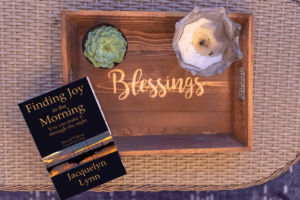
Some nights feel endless. Heavy with worry. Uncertain about what comes next.
In Finding Joy in the Morning: You Can Make It Through the Night, Jacquelyn Lynn reminds us that peace isn’t found in controlling circumstances — it’s found in trusting the One who already holds them.
This isn’t a self-help book.
It’s an I-can’t-do-it-alone book.
You’ll discover how to release anxiety, strengthen your faith, and build daily habits of joy — even in difficult seasons.
The expanded edition includes more than 40 practical joy practices and reflection questions for personal or group study.
Finding Joy in the Morning is available now on Amazon and wherever books are sold.
There’s a passage in the Gospel of Mark that can feel a little confusing at first. In fact, if you read it quickly, it almost seems unfair.
Jesus is walking with his disciples, and he sees a fig tree in the distance. It’s full of leaves—healthy, full, exactly what you would expect from a thriving tree.
So he goes to it, looking for fruit.
And there’s nothing.
Mark tells us, almost as an aside, that it wasn’t the season for figs. Which raises an obvious question—why would Jesus expect fruit if it wasn’t fig season?
Then Jesus says something striking. He speaks to the tree, saying, “May no one ever eat your fruit again!” (Mark 11:12-14, NLT) and later the disciples see that it has withered from the roots.
It’s a moment that makes you stop and think.
But when you understand the nature of fig trees in that region, it makes more sense. A tree that is fully covered in leaves should have had at least early fruit—small, edible figs. The leaves were a signal. An outward sign that fruit should be there.
But there wasn’t any.
The tree looked productive.
But it wasn’t.
And that’s where this stops being about a tree and starts being about us.
Because it raises a question for all of us—especially those of us who would say we follow Christ.
Are we producing fruit?
Or are we just… covered in leaves?
It’s easy to have the appearance of faith.
We can say the right things. We can show up at church. We can wear crosses, quote Bible verses, watch the right shows, nod along with the right ideas, and even listen to podcasts like this one.
From a distance, everything looks healthy.
But fruit is different.
Fruit isn’t what we say—it’s what shows up in our lives.
In how we treat people.
In how we handle pressure.
In how we serve.
In how we make decisions when no one else is watching.
Jesus didn’t say, “You’ll recognize them by their leaves.”
He said, “You will recognize them by their fruits.” (Matthew 7:16, ESV)
So what does that actually look like in real life?
It means your faith shows up in your work.
If you’re in business or leadership, bearing fruit means operating with integrity—even when cutting corners would be easier or more profitable.
It means treating people fairly. Keeping your word. Making decisions that reflect your values, not just your bottom line.
It means your faith shows up in your relationships.
You’re patient when it would be easier to snap.
You forgive when it would feel better to hold on to the offense.
You take time to encourage someone who needs it.
It means your faith shows up in how you serve.
Maybe that’s giving your time.
Maybe it’s giving your resources.
Maybe it’s noticing someone who feels overlooked—and making sure they know they matter.
And this doesn’t stop when you leave your workplace. Some of the most important fruit you’ll ever produce happens at home and in your everyday interactions. It shows up in how you speak to your spouse when you’re tired. In the patience you show your children or grandchildren. In whether you’re fully present with people—or distracted and distant.
It shows up in the small, unseen choices: choosing kindness over irritation, choosing to listen instead of interrupt, choosing to serve when no one is keeping score.
It also shows up in your character when no one else is around. The habits you build. The media you consume. The thoughts you dwell on.
A fruitful life isn’t divided into “spiritual” and “regular” time. It’s integrated. Your faith isn’t something you turn on for certain moments—it’s something that shapes who you are all the time, in every setting.
And sometimes, bearing fruit looks quieter than we expect.
It looks like prayer.
Consistent, faithful, behind-the-scenes prayer.
Because not everything God calls us to do is visible. But it all matters.
The point is not that every person does the same thing.
The point is that every believer does something.
A healthy tree produces fruit. It’s what it was created to do.
And the same is true for us.
If we identify as Christians—if we say we follow Christ—then our lives should reflect that in tangible ways.
Not perfectly.
But consistently.
This isn’t about performance. It’s about alignment.
It’s about asking: Does my life really match what I say I believe?
Because it’s possible to look the part.
It’s possible to be busy, involved, even respected—and still not be producing real, spiritual fruit.
That’s the warning in that fig tree.
Not condemnation—but clarity.
Don’t settle for looking fruitful.
Actually be fruitful.
And here’s the encouraging part: you don’t have to manufacture that fruit on your own.
Jesus said in John 15 that if we remain in him, we will bear much fruit.
Not might.
Will.
So the focus isn’t just on doing more.
It’s on staying connected to him—through prayer, through his Word, through daily dependence.
And then letting that relationship shape how you live.
A time is coming when everything will be revealed for what it is.
If someone looked at your life up close—not from a distance—what kind of fruit would they actually find?
Not what it looked like.
But what it actually produced.
So take an honest look at your life.
Not with guilt. Not with pressure.
But with clarity.
Where are you bearing fruit?
Where might God be calling you to step forward, to serve, to give, to speak, to act?
Because a life rooted in Christ will produce something.
And the goal isn’t to impress anyone.
It’s to faithfully reflect him.
Leaves are easy.
Fruit takes intention.
And fruit is what matters.
I’ll be back in a moment with this week’s real life tip.

What if your faith shaped your decisions—not just on Sundays, but every day at work?
Christian Business Almanac is a page-a-day guide designed for values-driven entrepreneurs, leaders, and professionals who want their faith to show up where it matters most.
Each day delivers Scripture, practical insight, and thoughtful reflection—helping you integrate biblical truth into leadership, work, and life.
This isn’t theory. It’s faith applied, one day at a time.
Learn more and find purchase links at ChristianAlmanac.com.
That’s ChristianAlmanac.com.
How many times have you received a voicemail message that rambled on, left out important information, or just didn’t make much sense?
And on the other side of that, how many times have you placed a call, reached someone’s voicemail, and left a message that you knew made you sound—let me be gentle here—less than intelligent?
This week’s real life tip is about leaving voicemail messages that actually get your calls returned.
It’s not difficult—it just takes a little planning.
Here are some simple tips you can use for both business and personal calls:
- Be prepared. Chances are good you’ll reach voicemail, so know what you’re going to say. You may even want to jot down a quick outline—just don’t sound like you’re reading it.
- Speak clearly and distinctly, and slow down when you’re giving phone numbers or other important details. Give the person time to write it down.
- If you’ve never called the person before, say your name and phone number twice—at the beginning and the end of the message. Yes, your number may show up on caller ID, but say it anyway. If you know the person well, you can skip the number—but still say your name.
- If it’s a business call, include the name of your company—even if you think they already know it.
- Say the date and time you’re calling. Yes, voicemail systems include that, but it’s still a helpful courtesy. Including your time zone is even better.
- Spell your name if the person doesn’t know you. This is especially important if your name is unusual—but it’s a good habit no matter what your name is.
- Give a clear reason for your call. Don’t just say, “call me back.” Let them know why you’re calling so they can be prepared when you talk.
- Let them know when you’ll be available for a return call. Avoid the back-and-forth of phone tag.
- And here’s the tough part: keep the whole message to 30 seconds or less.
With a little preparation and practice, you can leave voicemail messages that are clear, professional, and easy to respond to.
And when you do that, you’re not just increasing the chances your call gets returned—you’re also showing respect for the other person’s time.
That’s a small habit that makes a big difference.
Thanks for being here. See you next week.