
Christian Almanac: Where Faith Meets Real Life
Episode 27 Transcript
Transcript: Stop Trying to Fix Everyone. Start Leaving Things Better.
Click on the  in each section below to read the podcast segments
When does helping become taking over? Episode 27 looks at serving others without becoming responsible for their choices and outcomes—and at the everyday practice of leaving people, conversations, workplaces, and situations better than we found them.
Helping people is good.
Serving people is part of the Christian life.
But is it possible to help so much that our help becomes unhealthy?
Sometimes the desire to serve quietly turns into the belief that it’s our responsibility to fix everyone, protect everyone, and keep everything from falling apart.
We may never say that out loud. We may not even realize we believe it.
But somewhere along the way, helping becomes more than something we do. It becomes part of our identity. We need to be needed. We feel responsible for other people’s problems, for their decisions, and even the outcomes.
And sometimes we don’t recognize what’s happened until we’re exhausted, resentful, or surrounded by people who have learned to depend on us for things they should be learning to handle themselves.
This pattern is sometimes called a savior complex.
I’m not suggesting that everyone who helps too much has a psychological disorder. I’m using the term to describe a pattern—the belief that other people’s problems are ours to fix or carry.
Serving and helping others are noble actions. They’re things we are called to do.
But our motives and methods may need examination because good motives don’t automatically produce healthy methods.
The desire to help can become a need to rescue. We may believe everything will fall apart unless we step in, or feel guilty when we say no and let someone else face the consequences of a decision.
The issue is not simply how much we do.
The deeper question is why we are doing it.
Are we serving from love? Or are we serving from guilt or fear? Or is it a need for control, or a desire to feel important?
That can be difficult to admit, especially when our actions look generous from the outside.
Consider how this might happen in a work situation.
A manager has an employee who repeatedly misses deadlines or turns in poor work. Instead of addressing the problem directly, the manager keeps fixing the work, covering for the employee, and taking on the unfinished tasks.
The work gets done and a difficult conversation is avoided. But the manager becomes overworked and frustrated, while the employee never has to improve.
The rescue protects the employee from accountability, but it also prevents growth.
Helping would mean coaching, clarifying expectations, and allowing the employee to take responsibility. Rescuing means repeatedly taking over.
The same pattern can happen in families.
One person becomes responsible for everyone else’s emotions.
She tries to keep everyone happy, smooths over every disagreement, and changes her plans to avoid upsetting anyone.
Eventually, the entire family may begin to expect her to manage the emotional temperature of the room.
But one person can’t carry everyone else’s emotions.
We can be kind, listen, apologize when we’re wrong, and respond with compassion. But we can’t make sure no one is ever upset.
This can also happen in ministry.
A person begins serving because there’s a real need and a sincere desire to help.
Over time, though, service becomes identity.
Rest begins to feel selfish. Saying no feels like disobedience. Taking a break feels as though someone is being abandoned.
The person may continue serving long after exhaustion has set in because the ministry depends on her—or at least she believes it does.
But no ministry is strengthened by a person believing she has no limits.
There may be seasons of sacrifice, of hard work and long hours, but being faithful does not mean pretending we’re not human. We need rest, we need boundaries, and we need other people to participate. Sometimes the most responsible thing a leader can do is make room for someone else to serve.
This pattern may be especially difficult to recognize in friendships.
A friend is going through a crisis, and you want to be supportive.
You listen. You encourage. You pray. You offer practical help.
But gradually, support turns into managing that person’s life.
You remind him about appointments, solve his problems, make decisions for him, and become the first call whenever something goes wrong.
You may even begin to feel anxious when he makes choices you wouldn’t make.
At that point, the friendship is no longer simply supportive. You’ve assumed responsibility for another adult’s life.
That’s not sustainable for you, and it’s not helpful for him.
Constant rescue can communicate that the other person is incapable. It can also shield people from the consequences that may be part of how they learn.
This does not mean we should care less.
It does not necessarily mean we should do less, although sometimes it might.
It means we need to stop confusing our role with God’s role.
In First Corinthians, Paul wrote, “I planted the seed, Apollos watered it, but God has been making it grow. So neither the one who plants nor the one who waters is anything, but only God, who makes things grow” (1 Corinthians 3:6-7, NIV).
Paul recognized that our work matters. One person plants. Another waters. But neither one produces the growth.
Neither do we.
We may offer support, share what we can, and step in when it’s truly necessary, but we can’t force another person to change.
We can’t make someone become responsible, and we can’t guarantee the outcome.
That belongs to God.
So it’s not an issue of whether we care. Of course we do. It’s an issue of whether we have taken responsibility for something that was never ours in the first place.
When helping someone starts to feel heavy—or when you’re no longer sure whether you’re helping or taking over—it may be time to pause.
Ask yourself: Did God actually give me this responsibility, or did I pick it up on my own?
Is what I’m doing helping this person grow, or making it easier for them to stay dependent on me?
Am I acting out of love, or am I being driven by guilt, fear, or the need to stay in control?
Have I started treating constant availability as obedience? What is mine to do here, and what do I need to leave in God’s hands?
It’s also worth asking whether helping this person has caused you to neglect your own health, your other responsibilities, or the people who also need you.
The answers may be uncomfortable, but they can help you recognize when the way you’re helping needs to change.
And stepping back will probably be difficult.
The other person may resist. Someone who is accustomed to being rescued may not welcome a new boundary.
You may also feel guilty.
What if something goes wrong? What if the person is angry? What if they fail?
What if other people think you should have done more?
Those fears can make any boundary feel harsh, even when it’s necessary. But stepping back doesn’t have to mean disappearing or refusing all help.
It may simply mean changing the form of the help.
You don’t have to solve the problem the moment you hear about it. Sometimes the better response is to listen and ask, “What do you think you should do?”
You can offer specific help without taking over. You can let another adult face the consequences of a decision. And when the situation requires more than you can provide, you can point the person toward someone better equipped.
You can care, pray, and remain supportive without making the outcome your responsibility.
And if you’re on the receiving end of more help than you want, you may need a gentle conversation of your own.
You can acknowledge the person’s good intentions while making clear what support is welcome and what decisions remain yours.
Serving others is part of faithful Christian living.
But faithful service does not require us to take over another person’s life, prevent every consequence, meet every need, or guarantee every outcome.
Sometimes love steps forward.
Sometimes love stays beside someone without taking control.
And sometimes love steps back far enough to let another person carry what is theirs to carry.
Jesus is the Savior.
We are not.
We are servants and stewards. We are witnesses and leaders. We are friends, family members, neighbors, and caregivers. Our responsibility is to discern what is ours to do, respect our limits, and entrust the results to God.
When we come back, we’ll look at a simple principle that helps us serve faithfully without trying to fix everything: leave it better than you found it.
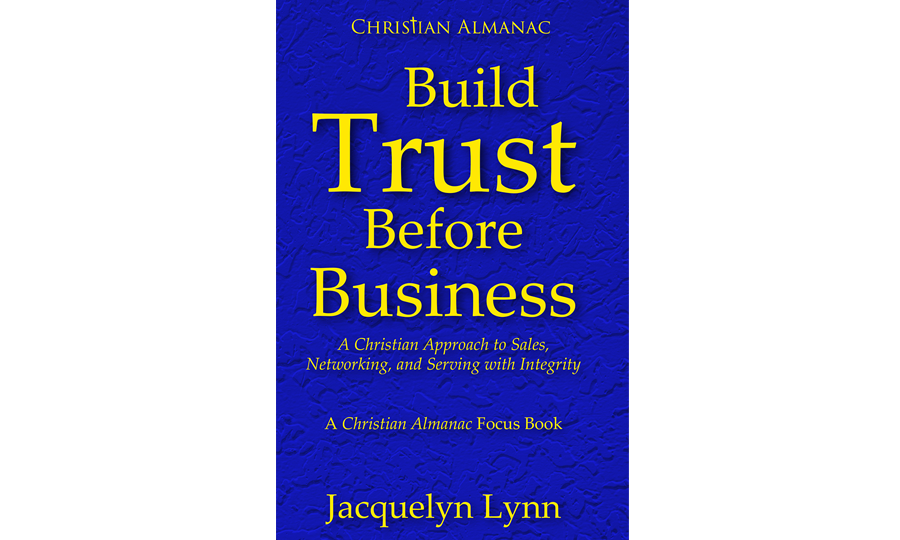
Sales and networking can sometimes make people feel as though they have to choose between growing their business and staying true to their values.
Build Trust Before Business offers another way.
This practical, faith-centered guide helps Christian professionals, business owners, entrepreneurs, salespeople, and ministry leaders approach sales and networking with honesty, wisdom, service, and respect.
Readers will learn how to explain what they offer clearly, listen before presenting, discuss price without pressure, respond to objections honestly, follow up respectfully, and build relationships that are generous rather than transactional.
Build Trust Before Business—a Christian Almanac Focus Book.
Welcome back.
My friend Krystal Parker, who is the president of the U.S. Christian Chamber of Commerce, told me that when she was a teenager and left for a babysitting job, her mother would always say, “Leave it better than you found it.”
At the time, Krystal thought that meant doing the dishes, picking up the toys, and straightening the room before she left.
But eventually she realized her mother had given her more than babysitting advice.
She had given her a way to live.
“Leave it better than you found it” is really a principle of stewardship. Every one of us has the opportunity—and I think the obligation—to improve the places we touch.
That doesn’t mean we have to take responsibility for everything. And it isn’t only about physical spaces.
Of course, the physical things matter. If we see trash on the ground, we can pick it up. We can hold a door, carry a package, put something back where it belongs, or clean up a mess instead of leaving it for the next person.
Those actions may be small, but they show that we noticed—and that we were willing to help.
But we leave more than spaces and sidewalks behind us.
We leave conversations. We leave atmospheres. We leave people.
Every place we enter is affected by what we bring into it and what we leave behind.
Sometimes leaving something better means bringing clarity to a confusing conversation. Maybe everyone is talking around the issue or making assumptions. One person slows things down, asks a useful question, and helps everyone understand what is actually being decided.
The whole problem may not be solved, but the conversation is clearer than it was before.
Sometimes leaving something better means bringing peace into a tense situation.
That doesn’t mean pretending everything is fine or avoiding a difficult subject. It may simply mean refusing to add more heat. A calm voice, an honest answer, or a little restraint can change the direction of a meeting, a family discussion, or an uncomfortable exchange.
Better does not always mean easier or more pleasant.
Sometimes better means more honest.
A hard conversation is not improved just because everyone avoids the hard part. It may be improved when someone tells the truth without becoming hostile.
A workplace is not improved when mistakes are covered up. It may be improved when expectations become clearer and people are held appropriately accountable.
A friendship is not improved when we only say what the other person wants to hear. Sometimes the kindest thing we can leave behind is truth spoken with care.
This principle also applies to the ordinary systems and routines around us.
You may document a decision so the next person doesn’t have to reconstruct what happened. You may simplify a confusing process. You may leave clear instructions instead of assuming everyone knows what you know.
None of that is dramatic. It may not even be noticed.
But it makes life easier for the person who comes next.
Paul wrote in Colossians 3:23, “Whatever you do, work at it with all your heart, as working for the Lord, not for human masters” (NIV).
The words “whatever you do” include ordinary tasks, unnoticed work, difficult conversations, and small acts of care.
Leaving something better is not about recognition. It’s about faithfulness.
But there’s an important limit.
Leaving something better doesn’t mean taking over.
We’re not responsible for fixing every person, organization, or problem we encounter. We can mentor without creating dependence. We can serve without needing to be seen as the rescuer. We can offer an idea without insisting that everyone accept it.
Sometimes our contribution is one useful thing—and then we let go.
That may be an encouraging word for someone who feels invisible.
It may be refusing to add gossip to a workplace.
It may be a clear note that helps the next person understand a decision.
It may be a tense moment handled with restraint.
It may be a task completed carefully instead of carelessly.
We do not have to transform the entire environment.
We can leave one thing better without trying to fix everything.
We all leave something behind when we move through a workplace, a family, a church, a community, or even a brief conversation.
That may be more peace—or it may be more tension.
More clarity or more confusion.
More trust or more suspicion.
The question is not whether we’ll have an effect. We will. We just need to decide what kind of effect that will be.
Leaving things better than we found them is not about taking over. It’s about noticing what’s ours to touch, doing that part faithfully, and leaving behind something useful for the person who comes next.
I’ll be back in a moment with this week’s Real Life Tip.

What if your faith shaped your decisions—not just on Sundays, but every day at work?
Christian Business Almanac is a page-a-day guide designed for values-driven entrepreneurs, leaders, and professionals who want their faith to show up where it matters most.
Each day delivers Scripture, practical insight, and thoughtful reflection—helping you integrate biblical truth into leadership, work, and life.
This isn’t theory. It’s faith applied, one day at a time.
Learn more and find purchase links at ChristianAlmanac.com.
That’s ChristianAlmanac.com.
Have you ever had to speak before a group of any size, even a small one, and looked out at a bunch of blank, disinterested faces? Or watched people scroll on their phones while you’re sharing important information?
This week’s real life tip isn’t about public speaking. It’s about being on the other side—it’s about being a good audience.
It takes a lot to get up in front of a group to speak or perform in some way. It takes preparation, practice, research, courage—and the willingness to risk looking foolish.
The audience doesn’t have anywhere near as much invested—just their time, and maybe the price of a ticket.
But when you’re in the audience, you have the opportunity to do something powerful. You have the opportunity to support and encourage the people who are brave enough to get up on a stage and inform or entertain you.
So here are a few reminders of things you can do to be a good audience.
One, pay attention. Watch and listen to what the speaker is saying or the performer is doing.
Two, engage if you can. If the room is small enough, smile, nod, or react appropriately. Make eye contact. If the speaker asks questions and they’re not rhetorical—frankly, when I’m in church and the preacher asks a question, I’m never sure if I’m supposed to answer out loud or not—but if you’re in a workshop or something similar and the speaker asks a question, answer it. If the speaker asks for volunteers, raise your hand.
Three, if there’s a question and answer session, ask a question. It shows that you were listening and you appreciated the information.
And when it’s over, thank the speaker. Do it in person at the event if you can. Send a note later if that’s appropriate.
Of course, what you do to be a good audience will vary depending on the situation, but when you’re in the audience, take a moment to put yourself in the shoes of whoever is at the front of the room or on the stage, and think about what you can do to be encouraging and show your appreciation.
A good audience doesn’t just receive what’s being offered—it helps the person at the front of the room give their best. And that’s a simple way to leave the experience better for everyone.
Thanks for being here. See you next week.